
Your kitchen sink gets more daily use than almost anything else in your home. It handles dirty dishes, raw meat, boiling water, acidic cleaning products, and the occasional dropped cast iron pan. Yet most homeowners spend more time choosing their cabinet hardware than their sink material.
That’s a mistake. The kitchen sink material you pick affects noise levels, durability, maintenance demands, resale value, and how well it holds up ten years from now. Get it right and you’ll barely think about it. Get it wrong and you’ll feel it every single day.
This guide covers all 11 types of kitchen sinks, breaks down the real pros and cons of each, and gives you a practical framework for making the right call.
Quick Comparison: All 11 Kitchen Sink Materials at a Glance
| Material | Durability | Maintenance | Cost Range | Best For |
| Stainless Steel | ★★★★☆ | Low | $150–$800 | Most kitchens |
| Granite Composite | ★★★★★ | Low–Medium | $300–$1,200 | Busy families |
| Quartz Composite | ★★★★★ | Low | $350–$1,000 | Modern kitchens |
| Fireclay | ★★★★☆ | Low | $400–$1,500 | Farmhouse style |
| Cast Iron | ★★★★★ | Medium | $300–$1,000 | Traditional kitchens |
| Copper | ★★★☆☆ | High | $500–$2,000 | Artisan/rustic |
| Natural Stone | ★★★☆☆ | High | $500–$2,500 | Luxury kitchens |
| Porcelain | ★★★☆☆ | Medium | $200–$900 | Classic aesthetics |
| Ceramic | ★★★☆☆ | Medium | $150–$700 | Budget-conscious |
| Acrylic | ★★☆☆☆ | Low | $50–$400 | Rentals/low traffic |
| Solid Surface | ★★★☆☆ | Low–Medium | $400–$1,200 | Seamless designs |
Why Your Sink Material Matters More Than You Think
Here’s a stat worth remembering: Americans replace kitchen sinks on average every 15 to 20 years. That’s two decades of daily use, thermal stress, chemical exposure, and physical abuse — all absorbed by one fixture.
Material choice affects more than looks. It determines:
- Noise level — Thin stainless steel rings like a bell. Dense composite barely registers a clank.
- Heat resistance — Acrylic warps. Granite composite laughs at a 500°F pot.
- Maintenance commitment — Copper and natural stone demand ongoing care. Stainless steel doesn’t.
- Cabinet compatibility — Cast iron and fireclay can weigh over 200 lbs. Your cabinets need to be ready.
- Resale value — A beautifully maintained fireclay or copper sink genuinely adds appeal to a home listing.
Bottom line: this isn’t a trivial choice. Let’s break it down material by material.
Stainless Steel Kitchen Sinks

Stainless steel dominates the market for a reason — roughly 70% of U.S. kitchens use it. Contractors love it. Designers default to it. Homeowners rarely regret it.
But not all stainless steel is equal. The two numbers you need to know are gauge and grade.
Gauge: Lower Is Thicker
| Gauge | Thickness | Best For |
| 16-gauge | ~1.5mm | Professional and high-use kitchens |
| 18-gauge | ~1.2mm | Most residential kitchens |
| 20-gauge | ~0.9mm | Budget purchases — avoid for heavy use |
A 16-gauge sink resists denting from dropped pots far better than a 20-gauge one. Don’t let a salesperson convince you otherwise.
Grade: 304 vs. 316 Stainless Steel
- 304 grade (T-304 surgical steel): The gold standard for residential sinks. Contains 18% chromium and 8% nickel — highly corrosion resistant.
- 316 grade: Adds molybdenum for even better corrosion resistance. Overkill for most homes but worth considering in coastal environments with salty air.
Pros of Stainless Steel:
- Lightweight and easy to install
- Non-porous — resists bacteria naturally
- Compatible with all mounting styles: undermount, drop-in, farmhouse
- Heat and rust resistant
- Easy to find replacement accessories
Cons of Stainless Steel:
- Shows water spots and fingerprints constantly
- Scratches visibly over time (though brushed finishes hide this better)
- Noisy without sound-dampening pads — studies show uninsulated sinks can produce 70+ decibels during dishwashing
- Can look cold in warm, traditional kitchen designs
“If you’re building a kitchen and don’t know what sink to get, get stainless steel. It’s been the industry workhorse for decades — and with good reason.” — National Kitchen & Bath Association (NKBA)
Buying Tips: Always check for integrated sound insulation or a spray-on undercoating. Brushed finishes hide scratches far better than polished ones. Stick to brands like Elkay, Kohler, or Kraus for reliable 304-grade stainless.
Granite Composite Sink
Walk into any kitchen showroom and granite composite is stealing the spotlight. It deserves the attention.
A granite composite sink is roughly 80% crushed granite mixed with 20% acrylic resin, compressed under high pressure. The result is a surface that’s harder than natural stone but far more forgiving to install.
Pros of Granite Composite:
- Virtually scratch-resistant — much harder than stainless steel
- Heat-resistant up to 536°F (280°C) — hot pots are no problem
- Excellent sound dampening due to its dense mass
- Rich matte colors that don’t fade over years of UV exposure
- Non-porous surface resists bacteria and stains
Cons of Granite Composite:
- Heavier than stainless — cabinet reinforcement is often needed
- Light-colored versions (white, beige) show mineral deposits and hard water staining more easily
- Higher price point than entry-level options
Buying Tips: Darker colors (black, anthracite, charcoal) are significantly more forgiving with hard water. Reputable brands include Blanco, Franke, and Elkay. Always check the manufacturer’s colorfast rating.
Quartz Composite Sink
Quartz composite is granite composite’s harder, denser cousin — and the two are frequently confused.
The key difference: quartz composite sinks use upward of 93% quartz crystals compared to granite composite’s 80% crushed granite. The result is a slightly harder, more uniform surface.
Pros of Quartz Composite:
- Among the hardest sink surfaces available — resists chips and scratches exceptionally well
- Completely non-porous — no bacteria, no staining
- Consistent color throughout the material — chips don’t reveal a contrasting core
- Pairs beautifully with quartz countertops for a seamless, modern look
Cons of Quartz Composite:
- Premium price tag
- Less widely available than granite composite
- Hard surface is unforgiving on dropped glassware
Buying Tips: Look for UV-stable pigments if your kitchen gets significant natural light — cheaper quartz sinks can fade near south-facing windows. Match the sink to your quartz countertop for a cohesive design.
Fireclay Kitchen Sinks
Few kitchen sink materials carry the visual authority of fireclay. It’s the go-to for the farmhouse kitchen sink look — and for good reason.
How it’s made: Clay is molded by hand into shape and kiln-fired at temperatures exceeding 1,800°F (982°C). This process fuses the glaze directly into the surface at a molecular level. It’s not a coating — it’s part of the material itself.
Pros of Fireclay:
- Incredibly dense and chip-resistant — harder than standard porcelain
- Stains sit on top of the glaze, not inside it — cleaning is genuinely effortless
- Handcrafted aesthetic — no two sinks are perfectly identical
- Long-lasting glossy finish that doesn’t dull over decades
Cons of Fireclay:
- Very heavy — large apron-front models can weigh up to 200 lbs. Cabinet reinforcement isn’t optional.
- Expensive, especially in farmhouse apron-front configurations
- Glaze can develop hairline cracks (called “crazing”) if exposed to sudden, extreme thermal shock — pouring boiling water directly on an ice-cold fireclay sink is a bad idea
Is Fireclay Worth the Investment?
For a farmhouse-style kitchen where longevity and aesthetics matter equally — yes, absolutely. A quality fireclay sink from a reputable maker can last 50+ years with basic care. Amortized over that lifespan, the cost is surprisingly reasonable.
Buying Tips: Leading brands include Rohl, Shaws Original (one of the oldest fireclay manufacturers in the world, founded 1897), and Kohler. Always verify your cabinet’s load-bearing capacity before ordering.
Cast Iron Kitchen Sinks
Cast iron is the material that refuses to retire. It’s been in American kitchens since the late 1800s and still outperforms most modern alternatives in raw durability.
Modern cast iron sinks use a porcelain enamel coating fired over the iron base — giving you the mass of cast iron with a smooth, easy-clean surface.
Pros of Cast Iron:
- Unmatched longevity — properly maintained cast iron can last multiple generations
- Outstanding sound dampening — the sheer mass absorbs impact and water noise
- Smooth enamel surface is easy to keep clean
- Available in a wide range of colors, including deep heritage tones unavailable in stainless
Cons of Cast Iron:
- Extremely heavy — large farmhouse models weigh 100 to 350 lbs
- Enamel chips if you drop heavy cast cookware; the exposed iron beneath can rust if ignored
- Cabinet reinforcement is almost always required
- Limited to drop-in or farmhouse mounting styles in most cases
Buying Tips: Check enamel thickness ratings before purchasing. Kohler and American Standard remain the most reliable manufacturers. Choose enamel interior colors carefully — they don’t fade but will stain from coffee, tea, and rust if neglected for extended periods.
Copper Kitchen Sinks
Copper is the most distinctive kitchen sink material on this list. It’s not for everyone — but for the right kitchen, nothing else comes close.
What makes copper genuinely different is its living finish. The surface develops a natural patina over time, darkening and shifting in tone based on use, water chemistry, and environment. Every copper sink becomes completely unique within a few years of use.
Pros of Copper:
- Natural antimicrobial properties — independent studies show copper surfaces kill 99.9% of bacteria within 2 hours of contact
- Develops a rich, one-of-a-kind patina that improves with age
- Extremely long lifespan when maintained correctly — copper plumbing in homes over 100 years old still functions perfectly
- Stunning visual impact in rustic, artisan, or eclectic kitchen designs
Cons of Copper:
- Reacts with acidic foods — citrus juice, vinegar, and tomato sauce can cause uneven patination or surface etching
- Requires regular oiling with a food-safe wax and specific pH-neutral cleaners — no bleach, no harsh detergents
- Highest price range of all 11 materials
Copper Sink Gauges
- 14-gauge copper: Best for a hammered copper sink — thicker, more resistant to denting
- 16-gauge copper: Suitable for most residential applications
- Recycled copper: An eco-conscious option with identical performance — and a good story to tell
Buying Tips: Avoid installing copper sinks adjacent to dishwashers — steam exposure from frequent dishwasher use accelerates and unifies the patina unevenly, producing a blotchy appearance. Hand-hammered finishes hide minor scratches and dents better than smooth copper.
Natural Stone Kitchen Sinks
Natural stone sinks are genuinely in a category of their own — in both beauty and maintenance demands.
The most common natural stone sink materials are granite, marble, soapstone, and travertine. Each behaves differently, and not all of them belong in a kitchen.
| Stone Type | Porosity | Kitchen Suitability | Sealing Needed |
| Soapstone | Very low | Excellent | Rarely |
| Granite | Low-medium | Good | Every 1–2 years |
| Travertine | High | Poor | Every 6 months |
| Marble | High | Poor | Every 6 months |
Soapstone wins for kitchen use. It’s naturally non-porous, heat-resistant, and develops a beautiful dark patina with mineral oil treatment. Marble and travertine, while gorgeous, are far too porous for a high-traffic kitchen sink.
Pros of Natural Stone:
- Genuinely one-of-a-kind appearance
- Extremely heavy and stable
- Soapstone is naturally non-porous and heat resistant
Cons of Natural Stone:
- Marble and travertine require sealing every 6–12 months without exception
- Significant chipping and cracking risk from impact
- Professional installation is essentially mandatory
- Highest installation cost of any material
Buying Tips: If you love natural stone but need practicality, consider a granite composite sink — it delivers a similar aesthetic at a fraction of the maintenance burden.
Porcelain Kitchen Sinks
Porcelain sinks are classic for a reason. That clean, bright white finish pairs with nearly every kitchen style — traditional, transitional, and farmhouse alike.
Porcelain is made from a kaolin clay base coated with a glass-enamel glaze. It’s denser than standard ceramic but softer than fireclay. The two are often confused — here’s the quick distinction:
Porcelain vs. Fireclay: Both use clay and a kiln-fired glaze. The critical difference is firing temperature. Fireclay is fired at 1,800°F+, creating a much denser, more durable surface. Porcelain fires at lower temperatures, producing a harder-than-ceramic but softer-than-fireclay result.
Pros of Porcelain:
- Smooth, non-porous surface wipes clean easily
- Bright white finish that complements nearly any aesthetic
- More affordable than fireclay
- Classic look with real staying power
Cons of Porcelain:
- Chips more easily than fireclay or cast iron
- Stains from coffee, tea, rust, and red wine if not cleaned regularly
- Slightly heavier than stainless but lacks cast iron’s durability
Buying Tips: Choose porcelain at least 3/8″ thick for better durability. Never use abrasive scrubbers — they dull the glaze permanently and create micro-scratches that trap staining agents.
Ceramic Kitchen Sinks
Ceramic sinks often get lumped together with porcelain, but they’re distinctly different materials — and generally less durable.
The key difference: ceramic uses earthenware clay fired at lower temperatures, producing a more porous, less dense result. Porcelain uses finer kaolin clay fired hotter, giving it superior density and hardness.
Pros of Ceramic:
- Budget-friendly entry point — accessible for renters or low-traffic kitchens
- Wide variety of colors, shapes, and styles
- Easy to clean when the glaze is intact
Cons of Ceramic:
- More prone to cracking and chipping than porcelain
- Glaze crazes (develops hairline cracks) over time, especially with thermal cycling
- Once the glaze chips, staining accelerates quickly
Buying Tips: Ceramic sinks work best as secondary sinks (bar sinks, laundry room sinks) or in low-traffic environments. Check glaze quality and thickness carefully before purchasing. For primary kitchen use, porcelain or fireclay are meaningfully better investments.
Acrylic Kitchen Sinks
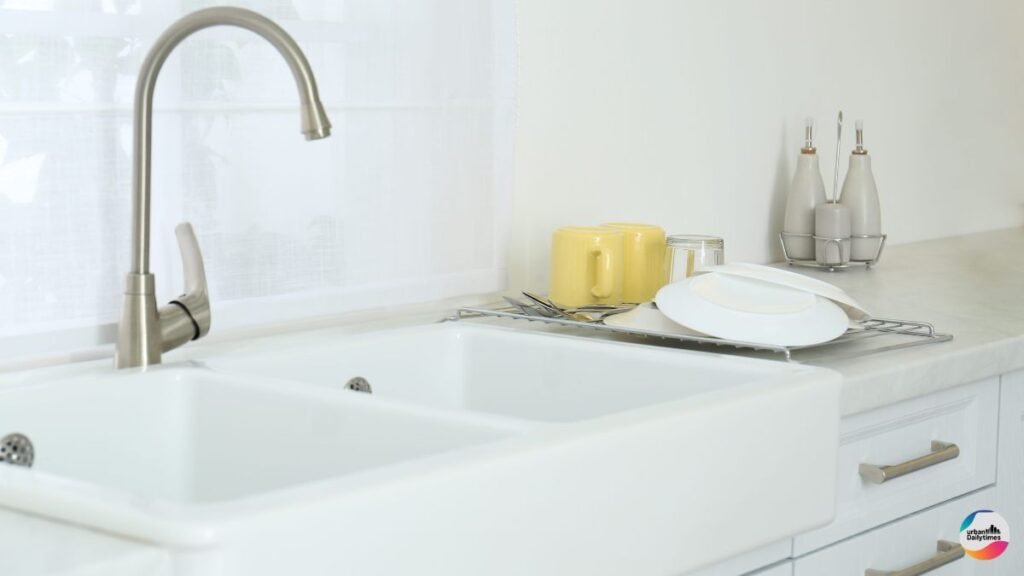
Acrylic sinks are thermoformed plastic — and they perform exactly as you’d expect from that description. Lightweight, inexpensive, and short-lived.
They’re common in rental properties, basement kitchens, vacation homes, and temporary installations. There’s no shame in that — they serve a specific purpose well. Just don’t expect them to last.
Pros of Acrylic:
- Lightest material on this list — easy solo installation
- Warm to the touch — gentler on glassware than hard materials
- Significant color variety
- Extremely affordable
Cons of Acrylic:
- Scratches permanently and easily — metal pots, abrasive sponges, even rings can mark the surface
- Heat-sensitive — temperatures above 140°F (60°C) can warp or discolor the surface
- Shortest realistic lifespan of all materials: 5 to 10 years with careful use
Buying Tips: Use a sink grid or protector mat on the basin floor to reduce direct contact damage. Never set hot pans directly in an acrylic sink under any circumstances.
Solid Surface Kitchen Sinks
Solid surface sinks — think Corian by DuPont or HI-MACS — blend acrylic resin with mineral fillers to create a smooth, matte, seamless surface. They’re most compelling when integrated directly with a matching solid surface countertop.
Pros of Solid Surface:
- Seamless installation eliminates crevices where bacteria and grime collect
- Scratches are repairable — light sanding with fine-grit sandpaper restores the surface
- Consistent color throughout — chips don’t reveal a contrasting material underneath
- Non-porous surface resists staining and bacteria
Cons of Solid Surface:
- Not heat resistant — temperatures above 212°F (100°C) cause permanent discoloration
- Less hard than stone or composite materials
- Premium brands carry premium prices; budget versions perform noticeably worse
Buying Tips: Corian by DuPont remains the most trusted and longest-proven brand. Pair the sink with matching countertop material for a clean, unified aesthetic that’s particularly effective in contemporary and minimalist kitchen designs.
Matching Your Sink Material to Your Kitchen Style
Choosing the right material means matching it to both function and aesthetic. Here’s a practical guide:
| Kitchen Style | Best Material Match | Why It Works |
| Modern/Minimalist | Stainless Steel or Quartz Composite | Clean lines, neutral tones |
| Farmhouse/Rustic | Fireclay or Copper | Handcrafted warmth and character |
| Traditional/Classic | Cast Iron or Porcelain | Timeless visual weight |
| Industrial | 16-gauge Stainless Steel | Raw, utilitarian authenticity |
| Luxury/High-End | Natural Stone or Copper | Unique, statement-making presence |
| Transitional | Granite Composite | Versatile — bridges modern and traditional |
The Smart Buyer’s Framework: 6 Questions Before You Buy
Don’t finalize your choice until you’ve answered these:
1. How heavy is your daily sink usage?
A family of five cooking three meals a day needs granite composite or stainless steel. A single professional who mostly orders takeout can afford more decorative options.
2. What’s your water type?
Hard water (high mineral content) is brutal on light-colored composite sinks, natural stone, and copper. If your municipality has hard water above 180 mg/L TDS, factor that into your material choice — or budget for a water softener.
3. Can your cabinets support the weight?
Cast iron, fireclay, and natural stone sinks commonly require cabinet reinforcement before installation. Budget for this upfront. Failing to do so causes cabinet floor failure — sometimes years later.
4. What’s your countertop material?
A fireclay apron-front sink with a quartz countertop requires precise cutout measurements and a compatible edge profile. Confirm compatibility before purchasing.
5. How much maintenance are you genuinely willing to do?
Be honest with yourself here. Copper is stunning — but if you’re not going to oil it seasonally and use only pH-neutral cleaners, it’ll look rough within two years.
6. What’s your realistic budget — including installation?
Material cost is only part of the story. A $600 natural stone sink may require $400–800 in professional installation and cabinet reinforcement. A $200 stainless steel sink may be a clean DIY job.
Undermount vs. Drop-In vs. Farmhouse: Material Compatibility
Undermount sinks mount beneath the countertop — requiring a thicker, denser material (at least 18-gauge for stainless steel, or any composite/stone material). They also create a clean countertop line with no rim to trap debris.
Drop-in sinks (top-mount) sit in a cutout with a rim resting on the countertop surface. They’re compatible with virtually every material and easier to DIY install.
Farmhouse (apron-front) sinks are almost exclusively fireclay, cast iron, or copper. Their exposed front panel is the design centerpiece — and the weight demands robust cabinet support in all cases.
Important note on warranty: Some manufacturers void sink warranties if the material is undermounted in a countertop type it wasn’t certified for. Always check the spec sheet before committing to a mounting style.
Hidden Costs Most Buyers Overlook
The price tag on the sink isn’t the whole story. Budget realistically for:
- Cabinet reinforcement: $150–$600 depending on cabinet condition and sink weight
- Professional installation: $200–$500 for standard installs; $400–$800 for heavy farmhouse sinks
- Ongoing maintenance products: Stone sealer ($15–$40/year), copper wax ($20–$60/year), specific pH-neutral cleaners
- Water filtration: If you have hard water, a quality under-sink filtration or softening system ($300–$700) protects your investment across every material
Final Verdict: Best Kitchen Sink Material by Buyer Type
| Buyer Profile | Best Material | Why |
| Best overall | Stainless Steel (16-gauge, 304 grade) | Durable, low-maintenance, universal compatibility |
| Best for families | Granite Composite | Scratch-resistant, heat-resistant, sound-dampening |
| Best farmhouse look | Fireclay | Handcrafted, durable glaze, authentic aesthetic |
| Best luxury statement | Copper or Natural Stone | Unique, striking, long-lasting |
| Best budget pick | Ceramic or Acrylic | Accessible price, acceptable for low-traffic use |
| Best seamless design | Solid Surface | Integrates with countertop, repairable surface |
FAQs
What is the most popular kitchen sink material in 2025?
Stainless steel remains the most commonly used sink material in American kitchens, with 16- to 18-gauge being the most practical range for homeowners — and that hasn’t changed in 2025.
What’s the best kitchen sink material for a busy family right now?
Stainless steel and granite composite lead the way in 2025 for their balance of performance and aesthetics — granite composite edges ahead for families thanks to its superior scratch resistance and sound dampening.
Does sink gauge actually matter when buying a stainless steel sink?
The grade and thickness of the stainless steel is vitally important — quality stainless steel sinks are made of 16-gauge thickness, and counterintuitively, the lower the gauge number, the thicker the material.
Are copper kitchen sinks hygienic?
Copper holds antimicrobial properties, meaning bacteria and viruses are eliminated directly on the surface — making it one of the most naturally hygienic sink materials available.
What’s the biggest mistake buyers make when choosing a kitchen sink material?
The gauge and quality of the sink’s material greatly impacts durability, longevity, and overall wear and tear more so than anything else — most buyers focus on looks and price while overlooking material thickness entirely.

Welcome to Urban Daily Times. My name is Malik Akmal, and I’m passionate about sharing practical home decor and home improvement ideas that help you create a better living space. With over 15 years of experience in home design, renovation trends, and product research, I focus on providing trustworthy advice that helps homeowners save money and choose the right solutions. Every product and recommendation featured on Urban Daily Times is carefully researched and reviewed to ensure you get honest, useful, and reliable information.


