
Bedroom curtain ideas cover the styles, fabrics, and design approaches used to dress a bedroom window, from soft neutral linens to bold printed statement pieces. Beyond simple decoration, curtains shape how much light enters a room, how warm it feels, and how private it stays. The right choice pulls an entire bedroom scheme together, tying wall color, bedding, and furniture into one cohesive look.
Here’s what most people miss: curtains affect sleep quality more than almost any other bedroom decision. A thin, unlined fabric can let in enough early morning light to disrupt melatonin production before an alarm ever goes off, while the right weight and lining can turn a bright east-facing room into a genuinely restful space. Fabric choice, in other words, is as much a sleep decision as a design one.
This guide brings together 18 bedroom curtain ideas for every style, from cottage pleats and matching pelmets to bold prints and dark, cocooning color schemes. Alongside the inspiration, you’ll find practical guidance on fabric weight, header styles, correct measuring, and made to measure curtains, so every idea here can actually be put into practice, not just admired.
Why Curtain Choice Matters More in a Bedroom Than Any Other Room
Curtains do more work in a bedroom than almost anywhere else in the house. In a living room, they’re mostly decorative. In a bedroom, they directly affect how well you sleep, how warm the room feels, and how private it is.
Light Control and Sleep Quality
The link between light exposure and sleep is well documented. The National Sleep Foundation notes that light is the strongest external cue your body uses to regulate its circadian rhythm, meaning even small amounts of light leaking through thin curtains can delay melatonin production and reduce sleep quality. This is why fabric choice for window curtains in a bedroom isn’t just aesthetic. It’s functional.
Insulation and Noise Reduction
Heavier fabrics and proper lining don’t just block light. They act as an extra layer of insulation against cold windows in winter and can noticeably dampen outside noise, particularly in older homes with single-glazed windows.
Softening the Room’s Overall Design
Beyond function, curtains soften hard architectural lines, add texture, and often become the single largest fabric surface in the bedroom scheme. Get the color, pattern, and drape right, and the whole room feels finished. Get it wrong, and even good furniture and paint choices can look flat.
How to Choose the Right Bedroom Curtains Before You Style Them
Before jumping into styles, it helps to understand the practical choices that shape how any curtain will actually perform and look once it’s hung.
Blackout vs. Thermal vs. Sheer — What Each One Actually Does
| Fabric Type | Best For | Light Blocked | Insulation |
|---|---|---|---|
| Blackout curtains | Shift workers, east-facing rooms, light sleepers | Up to 99% | High |
| Thermal curtains | Cold climates, older windows, energy saving | Moderate to high | Very high |
| Sheer curtains | South-facing rooms, layering, daytime softness | Minimal | Low |
| Standard cotton/linen | General use, balanced light control | Moderate | Moderate |
A common approach in professional interior design is to layer two of these together. Sheer linen curtains for daytime softness, paired with a blackout or thermal lining behind them for nighttime control. This layered approach also happens to be one of the most versatile bedroom curtain ideas on this list, since it works with almost any color scheme.
Choosing a Header Style
The header, or the way the curtain attaches to the pole, changes the entire look of the room:
- Pencil pleat – Traditional, gathered fullness, works well with a curtain pole or track
- Eyelet (grommet) – Casual, contemporary, creates soft folds
- Wave heading – Sleek and modern, sits close to the ceiling, popular in contemporary interior design
- Pinch pleat – Formal and tailored, often used in made to measure curtains
Curtain Length Rules
Getting curtain length right is one of the most common places DIY decorating goes wrong. There are three accepted lengths:
- Sill-length – Ends just below the windowsill, practical for radiators or window seats
- Floor-length (kiss the floor) – Just grazes the floor, the safest choice for most bedrooms
- Puddle length – Pools slightly on the floor, adds a luxurious, romantic feel but requires more fabric and maintenance
How to Measure Your Window Correctly
For a professional finish, the curtain pole should extend 15–20cm beyond the window frame on each side. This allows curtains to be pulled fully open during the day, letting in maximum light without covering any of the glass.
18 Bedroom Curtain Ideas by Style
Now for the inspiration. Each of these bedroom curtain ideas works within a distinct style, so you can match one to your existing bedroom decor or use it as a starting point for a full bedroom makeover.
Use a Bold Print to Draw the Eye
Bold prints turn curtains into a focal point rather than a background detail. This works particularly well in a bedroom with otherwise neutral walls and furniture, where the patterned curtains become the single statement piece in the room.
Choose Neutral Fabrics for a Serene Scheme
Neutral fabrics in oatmeal, stone, or soft grey create a calm, restful atmosphere, which is exactly what most people want from a bedroom. Neutral tones also age well and are far less likely to feel dated in five years compared to trend-driven prints.
Opt for Cottage Pleat Curtains
Cottage pleat curtains have a relaxed, slightly gathered fullness that suits country-style and traditional bedrooms. Unlike the crisp precision of pinch pleats, cottage pleats have an intentionally softer, lived-in look.
Create a Considered Look with Matching Canopy and Curtains
Coordinating canopy bed curtains with your window curtains creates a cohesive, boutique-hotel feel. This works best when the fabric is kept consistent across both, even if the canopy uses a lighter-weight version of the same print or color.
Embrace a More Playful Look for Children’s Bedroom Curtains
Children’s bedroom curtains can afford to take more risks than adult spaces. Bright colors, novelty prints, or themed designs suit a kids bedroom far better than muted neutrals. For a nursery curtains setup specifically, pairing a playful print with a blackout lining underneath solves both the style and the nap-time light control problem at once.
Frame a Garden View with a Floral Print
If your bedroom window looks out onto greenery, floral curtains with botanical prints can echo that garden view and blur the line between indoors and outdoors. This nature-inspired approach works especially well in country and farmhouse-style interiors.
Keep It Traditional with a Matching Pelmet
A pelmet hides the curtain pole and track, giving a tailored, formal finish that suits traditional and period-style bedrooms. Matching the pelmet fabric to the curtains themselves creates a seamless, considered look rather than a decorative afterthought.
Pair Bedroom Curtains with Blinds
Layering window blinds behind curtains gives you precise light control without sacrificing the softness curtains bring to a room. Blackout blinds paired with sheer or lightweight curtains is one of the most practical layered window treatments for bedrooms that get strong morning sun.
Lean into Lighter Shades
Light-coloured curtains in ivory, pale blush, or soft sage make small or dark bedrooms feel more open and airy. This is a particularly effective fix for light and airy bedroom schemes where the goal is to maximize the feeling of natural light.
Use Curtains for Decorative Details
Small details, like a contrasting trim, a decorative tieback, or a contrast lining visible when the curtain is open, add personality without requiring a full pattern change. These decorative trims are a low-cost way to elevate plain fabric curtains.
Create Cohesion with Matching Textiles
Pulling the curtain fabric, or a coordinating print, through to cushions and bed linen ties the whole bedroom scheme together. This is one of the simplest ways to make a room feel professionally designed rather than assembled piece by piece.
Create Contrast with Colourful Curtains
Against neutral walls and flooring, a bold colour scheme on the curtains alone can act as the room’s anchor point. This works particularly well with jewel tones like emerald, burgundy, or navy, which read as sophisticated rather than overwhelming.
Fit Curtains Behind Cornicing
For period properties with decorative cornicing, fitting the curtain pole behind or flush with the cornice line keeps the architectural detail visible and creates a cleaner, more seamless ceiling line.
Embrace Darker Schemes
A dark bedroom scheme using deep charcoal, forest green, or ink blue curtains creates a cocooning, cave-like feel that many people find genuinely more restful for sleep. Darker fabrics also tend to block more ambient light even without a full blackout lining.
Make a Feature of Awkward Corners
Bay windows, alcoves, and angled walls are common challenges in older homes. Rather than fighting the shape, curtains can be hung to follow the angle of the wall, turning what was an awkward space into a focal point with a window seat or reading nook underneath.
Achieve a Tailored Look with Made to Measure Curtains
Made to measure curtains are cut precisely to your window’s dimensions rather than a standard size, which means no pooling, no gaps, and no fabric bunched at the bottom. This is the difference between curtains that look store-bought and curtains that look bespoke.
Choose a Statement Colour
A single statement colour used confidently, rather than mixed with multiple competing tones, gives a bedroom a strong, cohesive identity. Deep terracotta, mustard, or dusty rose are current favorites in contemporary interior styling.
Elevate Curtains with Embellishments
Curtain embellishments like tassels, braid trim, or contrast borders add a couture feel to otherwise simple fabric. These details work particularly well on plain cotton curtains or linen curtains, where the embellishment becomes the visual interest rather than a print.
Bedroom Curtain Ideas for Common Layout Challenges
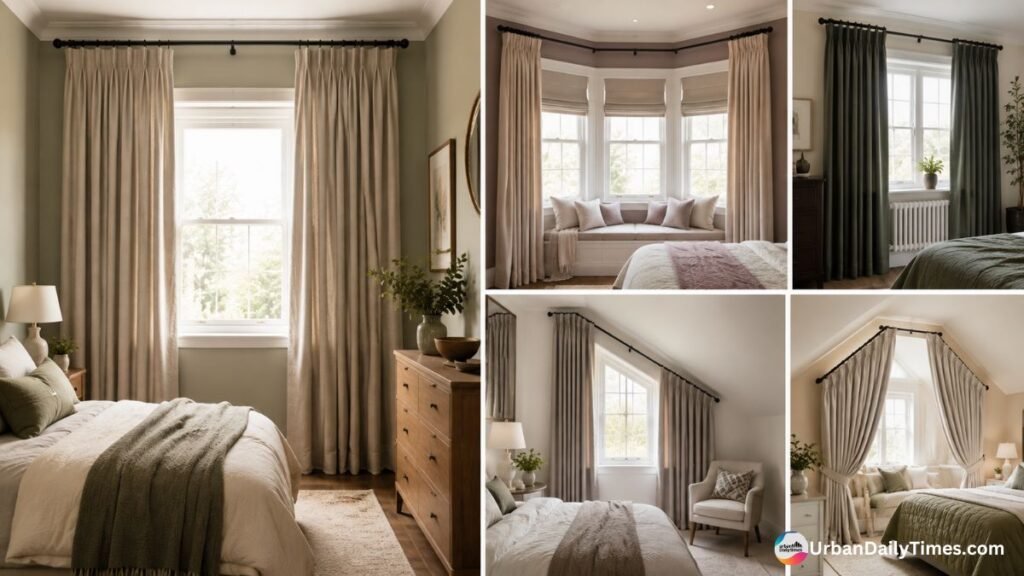
Not every bedroom has a standard rectangular window in the center of a flat wall. Here’s how to handle the layouts that trip most people up.
Small Bedrooms and Low Ceilings
Hang the curtain pole as close to the ceiling as possible, even above the actual window frame, to draw the eye upward and create the illusion of height. Floor-length curtains in a light-coloured or neutral fabric reinforce this effect.
Bay Windows and Angled Walls
Use a flexible bay window pole that follows the angle of the wall, and treat each section of the bay as its own curtain panel rather than trying to cover it with a single flat piece of fabric.
Windows Near Radiators or Furniture
Sill-length curtains avoid the safety and heat-efficiency issues that come from floor-length fabric draping over a radiator, while still providing a finished window dressing.
Sustainable and Natural Fabric Options
Natural fabrics are seeing a genuine shift in demand across home interiors, driven by both sustainability concerns and practical performance.
Linen is breathable, naturally moisture-wicking, and helps regulate temperature, making it a strong choice for bedrooms in warmer climates or south-facing rooms. Organic cotton offers a softer hand-feel and is widely available in both certified organic and recycled-blend options. Recycled polyester blends, made from post-consumer plastic, have also become more common in mid-range curtain ranges, offering a lower environmental footprint without the higher price tag of pure natural fiber.
Expert tip: Natural fibers like linen and cotton do wrinkle more easily than synthetic blends. If you want the natural look without the maintenance, look for a linen-cotton blend, which holds its drape better while keeping the breathable, textured feel.
How Much Do Bedroom Curtains Cost?
Costs vary significantly depending on fabric quality, curtain fullness, and whether you buy ready-made or made to measure curtains.
| Curtain Type | Typical Price Range (per window) | Best For |
|---|---|---|
| Budget ready-made (polyester blend) | $30–$80 | Rentals, temporary setups, kids’ rooms |
| Mid-range ready-made (cotton/linen blend) | $80–$200 | Most standard bedrooms |
| Made to measure (standard fabric) | $150–$400 | Non-standard window sizes, tailored fit |
| Made to measure (premium/designer fabric) | $400–$1,000+ | Statement rooms, period properties |
The biggest cost driver isn’t usually the fabric itself. It’s fullness, meaning how much fabric is used relative to the width of the window. A pencil pleat curtain with double fullness will cost noticeably more than the same fabric made up with minimal fullness, because it simply uses more material.
Common Bedroom Curtain Mistakes to Avoid
Even well-chosen fabric can look wrong if these basics are overlooked.
- Hanging the pole too low or too narrow — This makes windows look smaller and blocks light when curtains are open. Always extend the pole beyond the frame.
- Choosing the wrong fabric weight for the room’s light exposure — A sheer fabric in an east-facing bedroom will do very little to stop early morning light.
- Ignoring lining — Lining affects insulation, drape, and how the curtain looks from outside. Unlined curtains often look flimsy and let far more light through than expected.
- Skipping proper fullness — Curtains hung flat, with no gathering, rarely look intentional. Aim for at least 1.5–2 times the width of the window in fabric.
- Choosing floor-length in a room with radiators underneath the window — This creates both a safety issue and long-term fabric damage from heat exposure.
Key Takeaways
- Bedroom curtains directly affect sleep quality through light control, so fabric weight matters as much as style
- Layering sheer and blackout or thermal options gives the most flexibility for light control throughout the day
- Correct pole width, curtain length, and fullness make the biggest visual difference, often more than fabric choice itself
- Made to measure curtains are worth the investment for non-standard windows or a genuinely tailored finish
- Natural fabrics like linen and cotton are gaining popularity for both sustainability and breathability
- Small styling details, from matching textiles to decorative trims, tie a bedroom decor scheme together without a full redesign
Whether you’re drawn to a bold printed statement or a calm, neutral fabrics scheme, the right bedroom curtains come down to matching style with function. Get the length, fullness, and fabric weight right first, and almost any style on this list will look intentional rather than accidental.
Conclusion
Great bedroom curtain ideas always balance style with function. Fabric weight, curtain length, and fullness matter just as much as color or pattern. Whether you prefer soft neutral tones or a bold printed statement, the best results come from matching the look you want with practical choices like blackout lining or made to measure curtains. Small details, from trims to matching textiles, are what make a bedroom feel finished rather than half-done.
There’s no single right way to style a bedroom window. These bedroom curtain ideas work across different tastes, window shapes, and budgets, so you can pick what suits your space instead of forcing a trend that doesn’t fit. Get the length and fabric right first, and almost any style here will look intentional. That’s really what good bedroom curtains come down to: choices that look good and work well, night after night.
Frequently Asked Questions
What color curtains are best for sleep?
Darker, muted tones such as navy, charcoal, or deep green tend to support better sleep because they block more ambient light and create a calming, cocooning atmosphere, particularly when paired with a blackout lining.
Should bedroom curtains touch the floor?
For most bedrooms, floor-length curtains that just kiss the floor give the most polished, versatile look. Puddle length works well in more formal or romantic schemes, while sill-length is more practical over radiators or window seats.
Do you need blackout curtains in a bedroom?
Blackout curtains aren’t mandatory, but they make a measurable difference for light sleepers, shift workers, and anyone in an east-facing room. If you don’t want the heavier blackout look full-time, a separate blackout lining or blind layered behind lighter curtains offers the same benefit with more flexibility.
How wide should curtains be for a bedroom window?
As a rule, each curtain panel should be 1.5 to 2 times the width of the window when closed, to achieve proper fullness. The pole itself should extend 15–20cm beyond the window frame on each side.
Can you mix curtains and blinds in the same room?
Yes, and it’s one of the most practical layered window treatments available. Blinds handle precise light control, while curtains add softness, warmth, and a finished look to the overall bedroom scheme.

Welcome to Urban Daily Times. My name is Malik Akmal, and I’m passionate about sharing practical home decor and home improvement ideas that help you create a better living space. With over 15 years of experience in home design, renovation trends, and product research, I focus on providing trustworthy advice that helps homeowners save money and choose the right solutions. Every product and recommendation featured on Urban Daily Times is carefully researched and reviewed to ensure you get honest, useful, and reliable information.


