
Duvet Sizes Explained means matching the exact dimensions of a duvet, from cot bed to emperor, with the correct bed frame and mattress width, using standard UK, European, and US measurements to get proper coverage and a comfortable fit. Every size follows a set range in centimetres and inches, and knowing these numbers turns a confusing shopping trip into a five-minute decision.
Most people don’t realize a duvet is meant to overhang the mattress by 15 to 20cm on each side, and couples who upgrade from a double to a king duvet on the exact same bed frame report far fewer cold spots and far less overnight tug-of-war. That single sizing choice, not a new mattress or a thicker tog rating, is often the real fix for a restless night’s sleep.
This guide breaks down every standard duvet size, shows how UK, European, and US bedding measurements compare, and walks through how to measure your own bed correctly. You’ll also find guidance on tog ratings, duvet cover fit, and the sizing mistakes worth avoiding before you buy.
Duvet Sizes at a Glance (Quick Reference Chart)
Before diving into the details, here’s a duvet size chart covering every standard UK size in centimetres and inches. Keep this handy while you shop.
| Duvet Size | Dimensions (cm) | Dimensions (inches) | Best For |
|---|---|---|---|
| Cot Bed | 100 x 120–150 | 40 x 47–59 | Toddler beds, cot beds |
| Single | 135 x 200 | 53 x 79 | One sleeper, single bed frame |
| Small Double | 150 x 200 | 59 x 79 | Compact double rooms |
| Double | 200 x 200 | 79 x 79 | Standard double bed |
| King | 230 x 220 | 91 x 87 | King size bed frame |
| Super King | 260 x 220 | 102 x 87 | Super king bed, couples who move a lot |
| Emperor | 290 x 235 | 114 x 93 | Emperor bed, ultra-wide sleeping space |
These figures represent the standard duvet dimensions used by most major UK bedding manufacturers, though small variations of a few centimetres between brands are common, so always check the product listing before buying.
Standard UK Duvet Sizes Explained
Understanding each duvet size in more detail helps you match it to your exact bed frame and sleeping situation, not just the generic label.
Cot Bed Duvet Size
A cot bed duvet typically measures around 100 x 120cm, though some retailers extend this to 100 x 150cm for larger toddler beds. This is the smallest duvet in the standard range and is designed specifically for nursery and toddler use. Safety note: duvets are generally not recommended for infants under 12 months due to suffocation risk; most paediatric and NHS guidance recommends a firm, flat mattress with no loose bedding for babies. A cot bed duvet becomes appropriate once a child has transitioned out of a swaddled cot into a toddler cot bed.
Single Duvet Size
The single duvet measures 135 x 200cm and is designed for a standard single bed frame, which is usually 90cm wide. This size is common in children’s bedrooms, guest rooms, student halls, and box rooms. If you sleep alone and prefer a snug, contained duvet rather than one that spreads across a wider mattress, a single is the right call even on a slightly wider bed.
Double Duvet Size
The double duvet, at 200 x 200cm, is the most commonly purchased size in the UK, matching a standard double bed duvet frame of roughly 135cm wide. It suits one person who likes extra coverage or two people who don’t mind sharing a fairly close sleeping space. A small double duvet (150 x 200cm) also exists for the slightly narrower 120cm-wide small double mattress, which is easy to overlook but important to check if your bed frame falls into that in-between category.
King Duvet Size
A king size duvet measures 230 x 220cm, built for a king bed frame that’s typically 150cm wide. This is the most popular choice for couples because it provides enough width for two people to move without constantly pulling the duvet away from each other, a genuinely common complaint with double duvets shared by two adults.
Super King Duvet Size
The super king duvet comes in at 260 x 220cm, matching a 180cm-wide bed frame. Couples who run warm, move around a lot in their sleep, or simply want a hotel-style oversized feel tend to prefer this size even on a standard king mattress, since the extra width reduces the chance of exposed shoulders overnight.
Emperor Duvet Size
The emperor duvet is the largest standard size at 290 x 235cm, designed for emperor beds around 200cm wide. It’s a niche size mostly found in luxury bedding collections and larger family or guest beds where two adults, and sometimes a child or pet, share the space.
How to Measure Your Bed for the Right Duvet Size
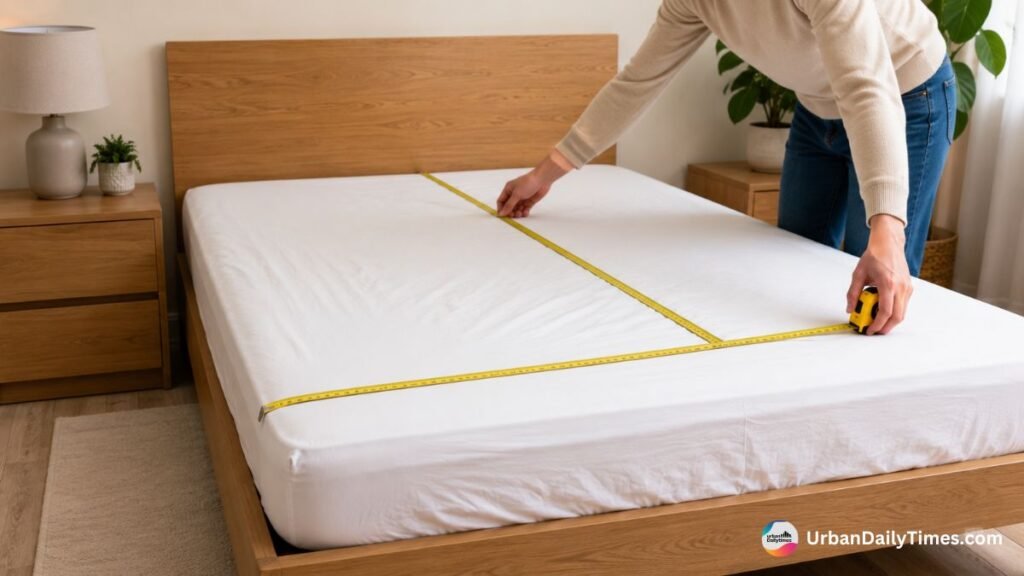
If you’ve moved into a new home, inherited an unlabelled bed frame, or just aren’t sure what size you’re dealing with, measuring directly removes the guesswork.
Measuring Mattress Width and Length
- Measure the width of your mattress from edge to edge, not the bed frame itself, since some frames have decorative borders that add extra width.
- Measure the length from head to foot.
- Round to the nearest standard bed dimensions category using the chart below.
| Mattress Width | Bed Size | Matching Duvet |
|---|---|---|
| 90cm | Single | Single duvet |
| 120cm | Small Double | Small double duvet |
| 135cm | Double | Double duvet |
| 150cm | King | King duvet |
| 180cm | Super King | Super king duvet |
| 200cm | Emperor | Emperor duvet |
How Much Overhang You Actually Need
A well-fitted duvet should hang roughly 15-20cm over each side of the mattress. That’s why duvet dimensions are always larger than the mattress itself, not just a coincidence of manufacturing. If you like a very generous drape or share your bed with a restless partner, sizing up one category (for example, choosing a super king duvet for a king bed) is a completely normal and popular approach.
Do Duvet Sizes Vary by Brand or Country?
This is one of the most searched questions around bedding sizes, and the honest answer is yes, meaningfully so.
UK vs European Duvet Sizes
European duvet sizes run differently from UK measurements, largely because continental Europe favours the “Scandi sleep method,” where couples use two single duvets side by side instead of one shared duvet. Common European sizes include 135 x 200cm, 155 x 220cm, and 200 x 200cm, but the naming conventions and exact centimetre measurements can shift by country, so a “double” in France isn’t guaranteed to match a UK double duvet exactly. Always check the cm measurements rather than relying on the size name alone when buying from a European retailer, including brands like IKEA, whose IKEA duvet sizes (for example, 150 x 200cm and 200 x 200cm) sit close to but not always identical with standard UK equivalents.
UK vs US Duvet Sizes (Twin, Full, Queen, King Compared)
US duvet sizes, more commonly called comforter sizes in America, use entirely different naming and measurements:
| UK Size | US Equivalent | US Dimensions (approx, inches) |
|---|---|---|
| Single | Twin | 68 x 86 |
| Double | Full/Double | 79 x 90 |
| King | Queen | 90 x 90 |
| Super King | King | 102 x 90 |
| Emperor | California King (closest match) | 107 x 94 |
Notice that a UK king duvet is closer in size to a US queen, not a US king. This mismatch trips up a lot of online shoppers buying from international retailers, so always cross-check the actual centimetre or inch measurements rather than assuming size names translate directly between countries.
Matching Your Duvet to Your Mattress Size
Your duvet and mattress don’t need to be labelled the exact same size, but they do need to work together sensibly.
Why a Slight Oversize Is Normal
As covered above, duvets are intentionally larger than the mattress to allow for overhang and tucking. A duvet that measures exactly the same as your mattress will look and feel undersized once it’s on the bed, since it flattens and shrinks slightly with use and washing.
What Happens If the Duvet Is Too Small or Too Large
- Too small: Cold spots along the edges, constant re-centring overnight, and a cramped look even when neatly made.
- Too large: Excess fabric bunching at the sides, a duvet cover that’s harder to fit properly, and in shared beds, one partner accidentally hogging more than their share simply because there’s extra material to pull.
Expert tip: If you’re torn between two sizes, sizing up is almost always the safer choice for shared beds, while sizing to the exact mattress width works better for single sleepers who value a neat, contained look.
Can You Put a Larger Duvet in a Smaller Cover (or Vice Versa)?
Short answer: not comfortably, and it’s not something we’d recommend as a long-term fix.
Risks of Mismatched Duvet and Cover Sizes
Putting a larger duvet into a smaller duvet cover causes the filling to bunch up, distort, and lose its even loft, which affects both warmth and appearance. It also puts strain on the cover’s seams and corner ties over repeated washes. Going the other way, a smaller duvet in a larger cover, leaves the duvet sliding around inside, clumping in one corner, and generally looking untidy no matter how well you make the bed.
When It’s Fine to Mix Sizes
A very slight mismatch, such as a small double duvet in a double cover, is generally tolerable and won’t cause major issues. But mixing sizes across a full category, like a single duvet in a king cover, isn’t a good long-term setup. If you’re between sizes, it’s worth buying matching duvet sets rather than mixing separates.
Choosing the Right Tog Rating for Your Duvet Size
Duvet fit is only half the equation. Duvet warmth, measured in tog, matters just as much for comfort regardless of which size you land on.
Tog Ratings by Season
| Tog Rating | Best Season |
|---|---|
| 2.5-4.5 tog | Summer |
| 7.5-10.5 tog | Spring/Autumn |
| 12-13.5 tog | Winter |
| 15+ tog | Very cold rooms or people who feel the cold |
All-Season and Combination Duvets
Combination or “4-in-1” duvets use two duvets, typically a lighter and a heavier one, buttoned together, letting you adjust duvet insulation across seasons without buying multiple full sets. These are worth considering if your bedroom temperature swings significantly between summer and winter, since it means only investing in one properly sized duvet cover rather than several.
Common Duvet Sizing Mistakes to Avoid
- Buying by bed frame name alone without checking the mattress’s actual measurements, especially with older or imported bed frames that don’t follow standard UK dimensions.
- Assuming international sizes match, when in reality US and European sizing rarely aligns exactly with UK standard duvet measurements.
- Choosing based on cover size instead of duvet size, leading to the bunching and slipping issues covered earlier.
- Ignoring tog rating and focusing purely on dimensions, which leaves you with a duvet that fits but sleeps too hot or too cold.
- Not accounting for shared beds, where two people on a double duvet often report far less satisfaction than two people on a king or super king duvet, according to widely repeated sleep industry guidance on shared bedding.
Duvet Care, Lifespan, and When to Replace It
A properly sized duvet still needs regular care to maintain its shape and loft. Most manufacturers and bedding retailers recommend washing synthetic duvets every three to four months and natural-fill duvets (down or feather) less frequently, following the specific care label, since over-washing can damage natural fillings. In terms of lifespan, synthetic duvets are generally recommended for replacement every two to three years, while good-quality down or feather duvets can last significantly longer, sometimes a decade or more, with proper care.
Signs it’s time to replace your duvet:
- Visible lumps or uneven filling distribution
- Persistent musty smell even after washing
- Flattened sections that no longer loft back up
- Frequent overheating or feeling cold despite correct tog rating
Real-World Example: Choosing Between Double and King
A useful way to see how these decisions play out is through a common real-world scenario. Consider a couple moving from separate single beds into a shared double bed frame. Their first instinct, understandably, is to buy a double duvet to match the mattress size exactly. Within a few weeks, they notice a familiar complaint: whoever moves more during the night ends up with the majority of the duvet, leaving the other partner exposed to cold spots along the edges.
Switching to a king duvet on the same double mattress resolves this almost immediately. The extra 30cm of width means both sleepers keep consistent coverage even with normal nighttime movement, without needing to replace the mattress or bed frame at all. This is one of the most consistent pieces of feedback found across UK bedding retailer reviews and customer guidance pages: couples sharing a double bed report noticeably higher satisfaction with a king-sized duvet than with a double, even though the mattress itself remains unchanged.
The lesson here applies more broadly. Duvet size doesn’t have to match mattress size exactly, and in shared beds specifically, sizing up is one of the simplest, lowest-cost comfort upgrades available, well below the cost of a new mattress or bed frame.
Duvet Size Decision Checklist
Use this quick checklist before you buy:
- [ ] Measured your actual mattress width and length, not just the bed frame name
- [ ] Checked whether you’re buying from a UK, European, or US retailer and confirmed cm/inch measurements
- [ ] Decided whether you want a snug fit or extra overhang, and sized up if sharing the bed
- [ ] Matched your duvet cover size to your duvet size, not your mattress size
- [ ] Chosen a tog rating suited to your room temperature and the season
- [ ] Confirmed care instructions match how often you’re willing to wash and store the duvet
Frequently Asked Questions
What size duvet do I need for a double bed?
A standard double bed, with a mattress around 135cm wide, needs a double duvet measuring 200 x 200cm. If you share the bed and prefer more room, a king duvet (230 x 220cm) is a popular upgrade even on a double mattress.
Is a king duvet too big for a double bed?
No, it isn’t. A king duvet on a double bed simply gives extra overhang and more coverage per person, which many couples actually prefer over a standard double duvet.
What’s the difference between UK and US king size duvets?
A UK king duvet (230 x 220cm) is closer in size to a US queen comforter, not a US king. A US king comforter is closer to a UK super king. Always compare exact measurements rather than the size name.
How do I know my duvet size if there’s no label?
Measure your existing duvet flat, corner to corner in both directions, and compare it against the duvet size chart earlier in this guide to find the closest standard match.
Can I use a super king duvet on a king bed?
Yes. It’s a common choice for people who want extra drape and warmth coverage, particularly in colder rooms or for restless sleepers who tend to pull the duvet during the night.
Do all duvet manufacturers use the same sizing?
Not exactly. While most major UK duvet manufacturers stick closely to the standard dimensions in this guide, small variations of a few centimetres are common, so it’s always worth checking the specific product listing before purchasing, especially when buying a duvet cover separately from the duvet itself.

Welcome to Urban Daily Times. My name is Malik Akmal, and I’m passionate about sharing practical home decor and home improvement ideas that help you create a better living space. With over 15 years of experience in home design, renovation trends, and product research, I focus on providing trustworthy advice that helps homeowners save money and choose the right solutions. Every product and recommendation featured on Urban Daily Times is carefully researched and reviewed to ensure you get honest, useful, and reliable information.


