
If you’ve got a 20×20 room and you’re trying to figure out exactly how much floor space you’re working with, here’s the short version: it’s 400 square feet. But that single number only gets you so far. Whether you’re buying flooring, arranging furniture, or just trying to picture how big the room actually feels, you need to know how that number was calculated and what to do with it next.
This guide walks you through the full process: the formula behind square footage, how to measure a room with a tape measure so your numbers are actually accurate, what to do if your space isn’t a perfectly square rectangle, and how that 400 square feet translates into real-world decisions like flooring, paint, and space planning. By the end, you’ll know exactly how to calculate, convert, and apply your room’s square footage with confidence.
The Quick Answer: A 20×20 Room Equals 400 Square Feet
A room measuring 20 feet by 20 feet has a total floor area of 400 square feet. This is one of the easiest sq ft calculation scenarios you’ll run into, because the room length and room width are identical, which makes it a true square rather than just a rectangle.
The Square Footage Formula (Length × Width)
The formula for square footage is simple:
Square Footage = Length × Width
For a 20×20 room, that’s 20 feet × 20 feet = 400 square feet. This length width multiplication is the foundation of nearly every room area calculation you’ll ever do, whether you’re sizing a bedroom, a garage, or an office.
| Room Dimensions | Calculation | Total Square Footage |
| 10 x 10 | 10 × 10 | 100 sq ft |
| 12 x 12 | 12 × 12 | 144 sq ft |
| 15 x 20 | 15 × 20 | 300 sq ft |
| 20 x 20 | 20 × 20 | 400 sq ft |
| 25 x 20 | 25 × 20 | 500 sq ft |
Why This Formula Works for Any Rectangular Space
Square footage measures floor area in two dimensions, so multiplying length by width gives you the total surface covered by the floor. This works for any rectangle, a square is just a special case where both sides are equal. The same logic applies whether you’re calculating a 10×12 bedroom or a 20×20 great room; the math never changes, only the numbers do.
How to Measure a Room Accurately, Step by Step
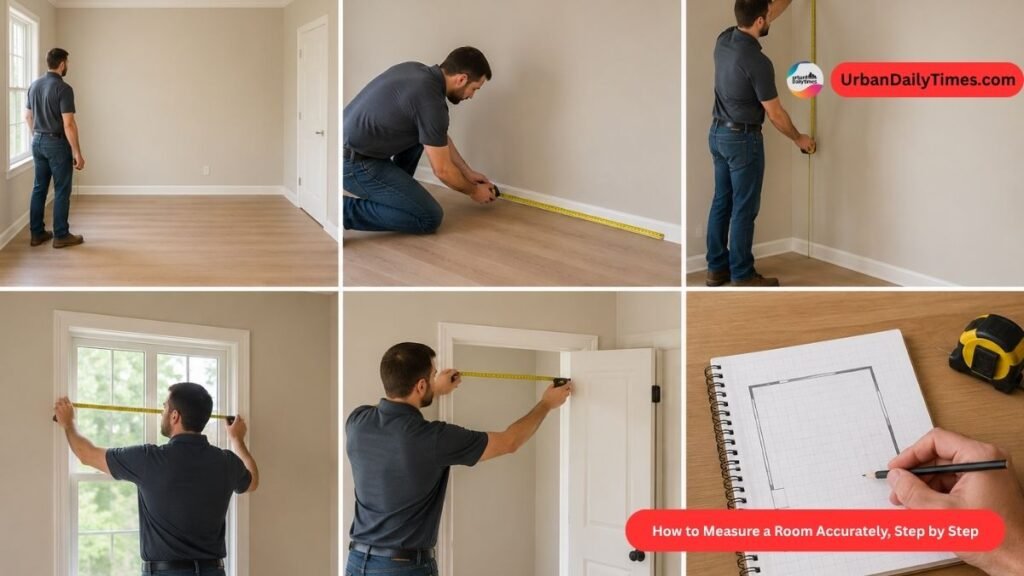
Getting an accurate room size starts with proper room measurements, and that means using the right tools and technique. A lot of space measurement errors happen not because the math is wrong, but because the initial measuring was sloppy.
Tools That Make Measuring Easier
You don’t need anything fancy, but a few tools make the job faster and more precise:
- Tape measure – a 25-foot retractable tape measure handles most residential rooms in one pass
- Laser distance measurer – useful for larger rooms or when working solo, since you don’t need someone to hold the other end
- Graph paper or a room-planning app – helpful for sketching the room shape before you calculate, especially for non-square spaces
- Notepad or phone notes app – to jot down each wall’s measurement as you go, so nothing gets forgotten
The Step-by-Step Measuring Process
- Clear the walls. Move furniture away from the perimeter so your tape measure can run flush along the baseboard.
- Measure the first wall. Run the tape from one corner to the other, recording the room length.
- Measure the adjacent wall. This gives you the room width. For a true 20×20 room, both numbers should read 20 feet.
- Double-check with a second measurement. Measure each wall twice, slight errors are common, and a second pass catches them.
- Multiply length by width. Once you’ve confirmed both room dimensions, apply the formula to get your total sq ft.
Where to Measure From
This is where many DIY measurements go wrong. You should measure interior wall to interior wall, not from the exterior of the house or from the outside edge of trim and baseboards. Measuring exterior walls instead of interior ones is a common reason a homeowner’s number doesn’t match what’s listed on a floor plan or appraisal report. If your room has thick walls or built-in shelving, measure from the finished interior surface, which is the actual usable floor space.
Calculating Square Footage for Rooms That Aren’t a Perfect Square
Not every room is a clean exact square. Many real homes have irregular room shapes, alcoves, closets, or bump-outs that complicate a simple length-times-width calculation.
L-Shaped Rooms and Bump-Outs
For an L-shaped or non-square room, the trick is rectangle division: break the irregular shape into two or more smaller rectangles, calculate each one separately, and add the results together.
For example, imagine a 20×20 room with an extra 5×8 nook attached to one wall:
- Main section: 20 × 20 = 400 sq ft
- Nook section: 5 × 8 = 40 sq ft
- Total: 440 sq ft
Rooms With Closets, Nooks, or Alcoves
Whether you include a closet in your total depends on what you’re calculating for. For flooring purchase purposes, you generally want to include closet floor space since that’s surface you’ll still need to cover. For furniture layout, you might exclude it since it’s not usable open floor. Always clarify your purpose before deciding what counts.
Adding Multiple Sections Together for a Total
This area addition method, sometimes called area division, works for almost any complex floor plan:
- Sketch the room’s outline on paper
- Draw straight lines to divide it into rectangles or squares
- Measure and calculate each room section individually
- Add every section’s square footage together for your final total area
Converting 400 Square Feet Into Other Units
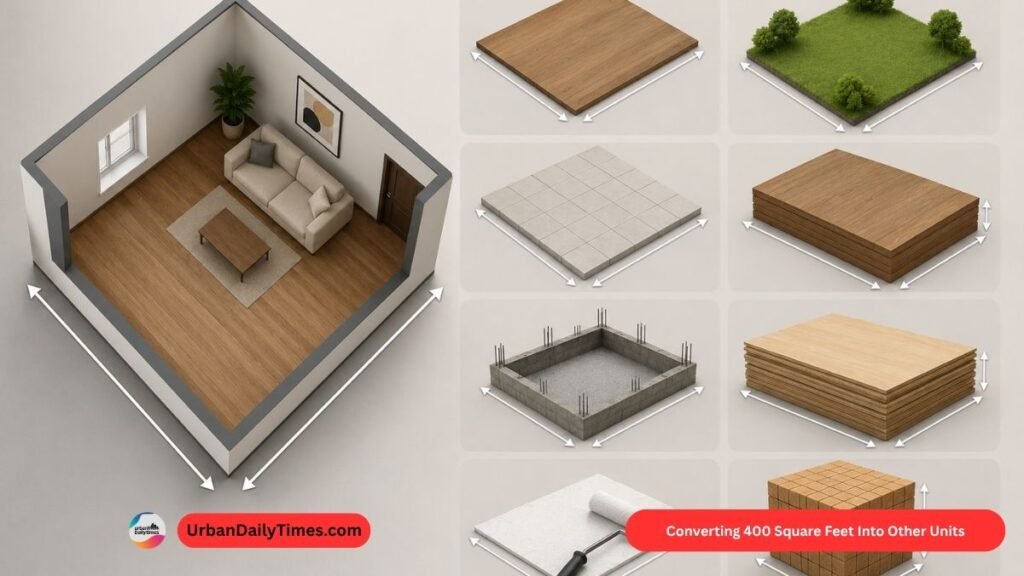
Once you have your 400 sq ft figure, you may need it in a different unit depending on what you’re buying or comparing.
Square Feet to Square Yards (for Carpet and Flooring Orders)
Carpet and some flooring materials are sold by the square yard, not the square foot. Since 1 square yard equals 9 square feet, you divide your total by 9:
400 ÷ 9 = 44.44 square yards
Knowing this conversion in advance helps you compare pricing accurately when a flooring quote is given per yard instead of per square foot.
Square Feet to Square Meters
For international products, blueprints, or metric specifications, convert square feet to square meters by multiplying by 0.092903:
400 × 0.092903 ≈ 37.16 square meters
| Unit | Conversion Factor | Result for 400 sq ft |
| Square Yards | ÷ 9 | 44.44 sq yd |
| Square Meters | × 0.092903 | 37.16 sq m |
| Acres | ÷ 43,560 | 0.0092 acres |
Putting 400 Square Feet Into Perspective
Numbers are more useful when you can actually picture them. So how big is 400 square feet in practical terms?
Everyday Spaces That Are Roughly This Size
- A standard two-car garage
- A large studio apartment (many studio units in major U.S. cities fall in the 400–500 sq ft range)
- A spacious primary bedroom with a sitting area
- A small backyard guest house or accessory dwelling unit (ADU)
Is 400 Square Feet Large or Small, Depending on the Room
Context matters enormously here. For a bedroom, 400 square feet is generous, well above the U.S. average primary bedroom size. For a living room or open-concept great room, it’s comfortable but not oversized. For a garage or workshop, it’s a practical, functional size that fits two vehicles or a full home gym setup with room to spare.
Common Square Footage Mistakes That Throw Off Your Number
Even simple dimensions calculation can go wrong in predictable ways. Watch for these:
- Measuring exterior walls instead of interior walls, which inflates your number beyond the true usable space
- Forgetting closets, nooks, or alcoves when the goal is total flooring coverage
- Mixing units mid-calculation, like measuring one wall in feet and another in inches without converting
- Rounding too early, which compounds small errors across a large purchase like flooring or paint
- Assuming a “square” room is actually square without verifying both walls are equal length, since older homes often settle unevenly over time
Why Your Square Footage Number Matters: Real-World Uses
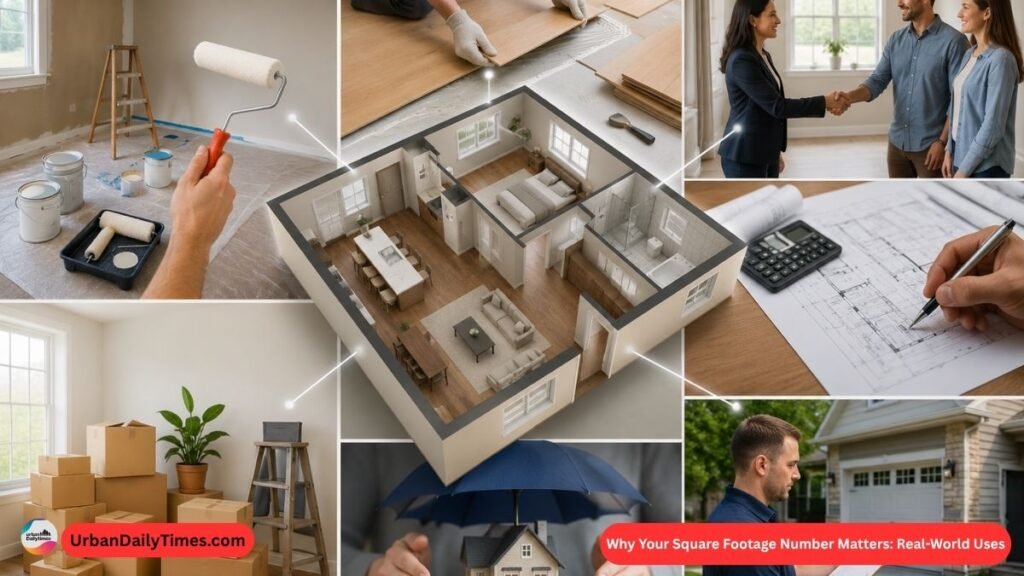
Calculating square footage isn’t just an academic exercise. It directly affects budgeting, shopping, and home renovation decisions.
Estimating Flooring and Carpet
Flooring is almost always priced per square foot or square yard, so an accurate flooring calculation keeps you from underordering (and running short mid-project) or overordering (and wasting money). Most installers recommend adding 5–10% extra for cuts and waste, meaning a 400 sq ft room would need roughly 420–440 sq ft of material ordered.
Calculating How Much Paint You Need
Paint coverage is typically based on wall area, not floor area, but your room’s footprint still matters for ceiling height calculations and trim estimates. A standard gallon of paint covers approximately 350–400 square feet of wall surface with one coat, according to most major paint manufacturer guidelines.
Planning Furniture Layout
Square footage is central to furniture arrangement and furniture layout planning. Knowing you have 400 square feet to work with helps you decide realistically how many seating pieces, storage units, or workstations the room can comfortably hold without feeling cramped. Many interior designers recommend keeping at least 30% of floor space clear for walkways and natural movement.
Real Estate Listings and Appraised Value
Square footage directly affects appraised value and listing price in real estate. Appraisers calculate gross living area using standardized methods (commonly ANSI Z765 guidelines in the U.S.), so understanding how your own measurements compare to an official appraisal can help you spot discrepancies before a sale.
Sizing Heating and Cooling Systems (BTU needs)
HVAC sizing depends heavily on square footage. A common industry rule of thumb is roughly 20 BTUs per square foot for average climate conditions, meaning a 400 square foot room would need approximately 8,000 BTUs of cooling capacity, though insulation quality, ceiling height, and window exposure can shift that number.
Manual Math vs. Online Square Footage Calculators
Both approaches work, but they serve different purposes.
| Method | Best For | Limitation |
| Manual calculation | Simple rectangular rooms, learning the formula | Slower for complex, irregular shapes |
| Online calculator / design software | Irregular rooms, multiple sections, unit conversions | Requires accurate input measurements to be useful |
For a straightforward 20×20 room, doing the math by hand takes seconds. For a multi-section floor plan with several room layout quirks, a calculator or design software tool can save time and reduce the chance of arithmetic mistakes, but only if your initial measurements are correct. As the saying goes, garbage in, garbage out, no calculator can fix an inaccurate tape measure reading.
Frequently Asked Questions
How many square feet is a 20×20 room?
A 20×20 room is exactly 400 square feet, calculated by multiplying the 20-foot length by the 20-foot width.
Is 400 square feet a good size for a bedroom?
Yes, 400 square feet is considered spacious for a bedroom, well above the typical U.S. primary bedroom average, and would comfortably fit a king bed, seating area, and ample storage.
Is 400 square feet a good size for a garage or shop?
Yes, 400 square feet comfortably fits two standard vehicles or a single vehicle plus a dedicated workspace, making it a popular size for home garages and small workshops.
How do I calculate square footage if my room isn’t a perfect rectangle?
Break the room into smaller rectangles, calculate the square footage of each section individually, then add all the totals together for the final number.
How much does flooring typically cost for a 400 square foot room?
Flooring costs vary widely by material, ranging from a few dollars per square foot for basic vinyl to significantly more for hardwood or natural stone, so it’s best to get a quote based on current local material and installation pricing.
What’s the difference between square footage and square yardage?
Square footage measures area in square feet, while square yardage measures the same area in square yards. Since 1 square yard equals 9 square feet, you divide square footage by 9 to convert to square yards, which matters most when comparing carpet or flooring quotes priced per yard.

Welcome to Urban Daily Times. My name is Malik Akmal, and I’m passionate about sharing practical home decor and home improvement ideas that help you create a better living space. With over 15 years of experience in home design, renovation trends, and product research, I focus on providing trustworthy advice that helps homeowners save money and choose the right solutions. Every product and recommendation featured on Urban Daily Times is carefully researched and reviewed to ensure you get honest, useful, and reliable information.


