
The Biggest 1980s Trend Designers point to is wall-to-wall carpet, the decade’s habit of covering every room, including bathrooms and kitchens, in synthetic fitted carpet. Working professionals still name it first when asked which retro style deserves to stay buried, since it caused real problems with hygiene, upkeep, and home value that go far beyond simple taste.
Here’s what makes this topic worth a closer look. The ’80s is quietly making a comeback right now, with brass hardware, fluted surfaces, and bold wallpaper showing up in fresh, modern homes. Yet carpet never got invited back. That gap between what’s returning and what stays rejected says a lot about which design choices actually hold up over time.
This guide breaks down exactly why wall-to-wall carpet lost its place, which other 1980s surfaces and habits still make designers wince, and how to spot these outdated choices in your own home. You’ll also get practical, low-cost fixes so updating a dated space doesn’t require a full renovation.
Why the ’80s Keeps Haunting Modern Homes
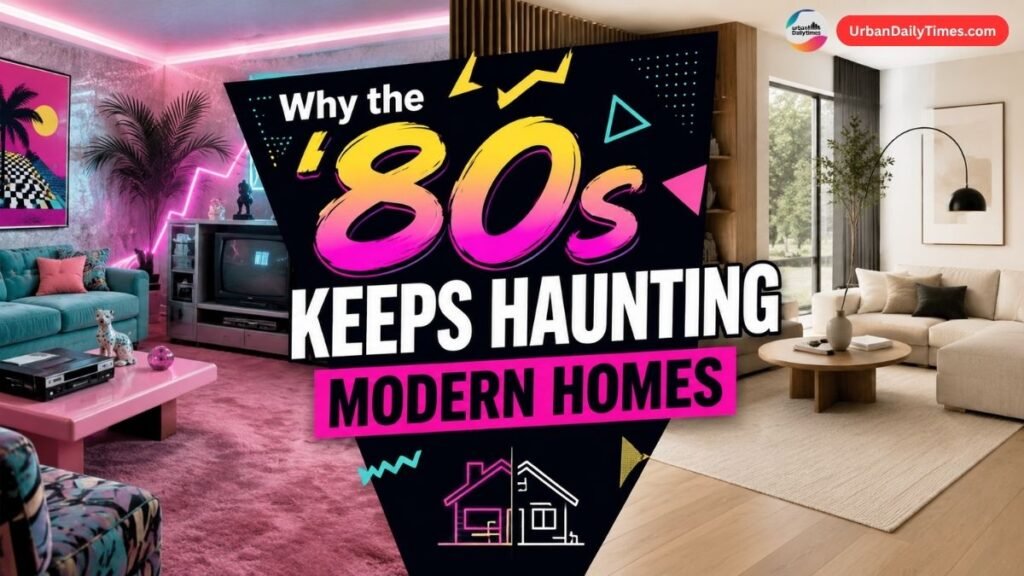
Design trends move in cycles, usually resurfacing 20 to 40 years after their original run once enough distance builds up nostalgia and enough time passes for a style to feel fresh instead of dated. That’s roughly where we are with the 1980s. A generation raised on beige minimalism is now decorating their first homes, and they’re pulling from the exact decade their parents spent the 2000s and 2010s trying to erase.
That’s what makes this topic more interesting than a simple “outdated decor” list. The ’80s isn’t fully rejected. Parts of it are back in serious rotation. But one trend in particular has almost no defenders left among working professionals, and understanding why reveals a lot about how home decor actually ages.
The ’80s Design Revival Happening Right Now (and Where Designers Draw the Line)
According to Liz Williams of Liz Williams Interiors, the 1980s combined bold, eclectic styles that mixed luxury with playful, futuristic elements, with neon colors and pastels popularized by shows like Miami Vice. Several of those elements are back on trend boards in 2026:
| ’80s Element | Status Today | Why It Works Now |
|---|---|---|
| Fluted and reeded surfaces | Trending strongly | Adds texture without clutter; works in minimalist decor |
| Curvy, rounded furniture | Trending strongly | Softens modern interiors, photographs well |
| Bold wallpaper (ceilings included) | Trending strongly | Personality-driven decorating ideas replacing all-white rooms |
| Brass and warm metal hardware | Trending strongly | Pairs with both traditional and contemporary homes |
| Neon and pastel accent color | Trending, used sparingly | Contrast to years of gray-and-white minimalist spaces |
| Wall-to-wall carpet | Rejected | Hygiene, maintenance, and resale concerns (below) |
| Glass block walls | Rejected outside niche uses | Reads as dated rather than retro-cool |
| Matchy-matchy coordinated rooms | Rejected | Feels like a showroom style, not a lived-in home |
Interior designer Meghan Jay of Meghan Jay Design puts it this way: one of her favorite aspects of 1980s home design is the cozy, lived-in feel of the spaces, and that’s specifically what today’s maximalist revival is chasing — comfort with personality, not the excess for its own sake. That distinction matters, because it’s exactly where wall-to-wall carpet loses the argument.
The Verdict — Wall-to-Wall Carpet Is the 1980s Trend Designers Want Gone for Good
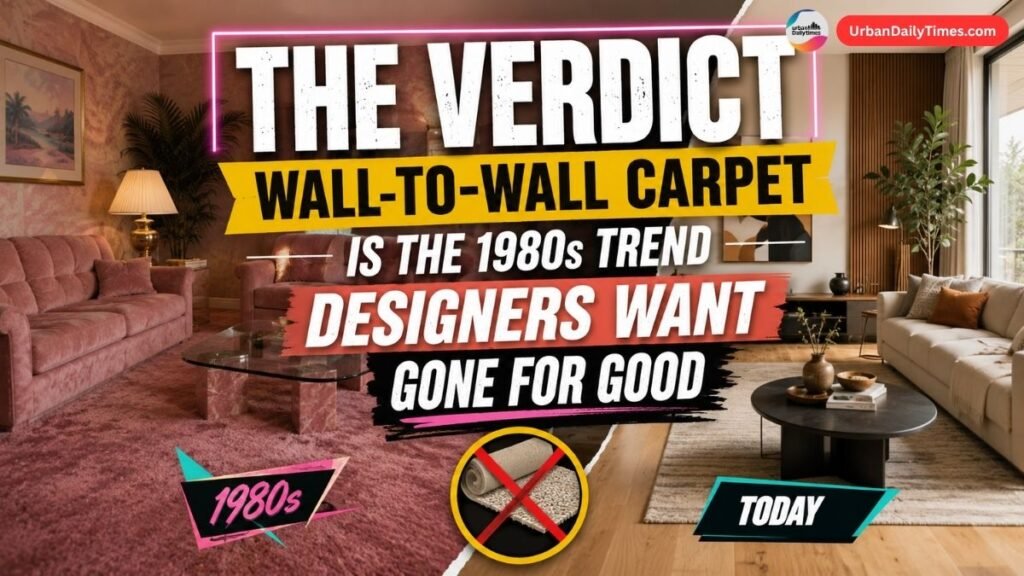
Ask around and the consensus is remarkably consistent. Nancy Epstein, founder and chairman of Artistic Tile, doesn’t hold back: as a frequent traveler, she’s appalled to walk into a hotel room with carpeting, wondering whose feet were on it last. New York-based designer Paris Forino goes further, calling bedroom carpet and wall-to-wall installations “dated and suburban,” and directly ties the look back to its 1970s-1980s origin.
That’s the throughline across the industry: wall-to-wall carpet, sometimes called broadloom carpet, isn’t rejected because carpet itself is bad. It’s rejected because of how the 1980s used it — everywhere, in every color, in every room, including the ones where it never belonged.
Why It Took Off in the First Place
Carpet wasn’t always considered cheap or dated. Before the mid-1900s, wall-to-wall carpet was a genuine status symbol, and DuPont’s development of new synthetic fibers made it an affordable luxury for the first time. By the 1980s, the introduction of Berber carpet — a durable, looped style resistant to visible footprints — changed the equation again. Homeowners became more confident about floor covering durability, and that confidence led directly to overreach.
Designers describe the era’s mentality as a simple “why not?” Cold tile next to the bathtub? Cover it in plush, peach-colored carpet flooring. The same decorating trends driving preppy pastels and Dynasty-inspired opulence pushed carpet into bathrooms, kitchens, and anywhere else it could physically be installed.
Why Designers Turned on It
The reasons home designers cite today go well beyond aesthetics:
- Allergens and trapped debris. Carpet fibers hold dust, pet dander, and allergens far more than hard flooring, which matters more now that indoor air quality gets far more attention in home renovation decisions than it did in 1985.
- Moisture and mold risk. Carpeted bathrooms — a genuine 1980s habit — trap humidity against padding and subfloor, creating conditions hard flooring simply doesn’t have.
- Staining and compaction. High-traffic living spaces show wear fast: matted fibers, visible furniture indentations, and stains that don’t fully lift even with regular carpet cleaning.
- Resale perception. Buyers and real estate agents alike read wall-to-wall carpet as an immediate renovation item, which can suppress a home’s perceived value compared with hardwood, tile, or engineered flooring.
Design historian and product specialist Katherine Cohen of FLOR sums up the shift plainly: better flooring options simply became available, so wall-to-wall carpet was replaced, with area rugs used instead to keep high design and comfort underfoot — without the maintenance headache of covering an entire floor.
The One Exception Designers Will Still Defend
Not every professional treats wall-to-wall carpet as a lost cause. Furniture designer Mark Grattan installed mint-green wall-to-wall carpet throughout his Mexico City home, describing carpet as ideal for “the person who finds pride in cleanliness,” and reserving it for low-traffic rooms like bedrooms. Crosby Studios founder Harry Nuriev went further, using purple wall-to-wall carpet throughout his own apartment and pushing back on the stigma entirely.
The nuance worth remembering: designers aren’t rejecting carpet as a material. They’re rejecting the fitted carpet everywhere mindset — carpeted bathrooms, carpeted kitchens, and carpet chosen for cost rather than intention. Used selectively, in a bedroom or a formal sitting room with minimal foot traffic, wall-to-wall carpet still has defenders. Used the way the 1980s used it, it doesn’t.
Other ’80s Flooring and Surface Trends Designers Refuse to Revisit
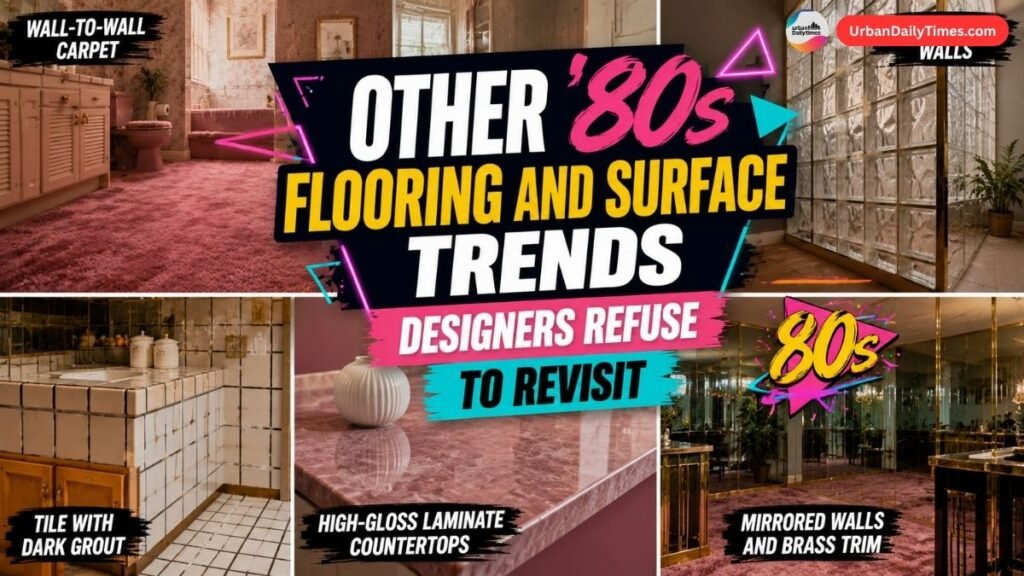
Carpet tops the list, but it’s not alone. A handful of other flooring trends and surface choices from the decade get mentioned just as consistently by decorating experts.
Carpeted Bathrooms
This deserves its own callout separate from carpet in general, because it’s the single most-cited example of 1980s excess. Showering feet away from carpeting creates an environment for mold, mildew, and odor that no amount of vacuuming solves. Designers overwhelmingly point to this specific application — not carpet as a category — as the clearest case of a trend that should never return.
Popcorn Ceilings
Popcorn ceilings actually predate the 1980s, first appearing after WWII as a fast, single-coat way to hide poor drywall work while builders raced to meet postwar housing demand. Their ’80s-era popularity ran headfirst into a bigger problem: many older popcorn ceilings contain asbestos, which is why professional testing and removal — not DIY scraping — is the standard recommendation today. Beyond the health concern, they simply read as dated texture in an era of clean, flat ceilings.
Brown-Speckled Granite and Busy Countertop Laminate
Interior designer Kevin Francis O’Gara doesn’t mince words about speckled stone: he’d be happy to never see brown-speckled granite countertops return, arguing that it makes kitchens look perpetually dirty and drab rather than clean. Tiled countertops from the same era face a related complaint — grout lines that are, in Audrey Scheck’s words, “impossible to keep clean.” Both trends get replaced today by quartz, honed marble, or solid-surface counters that don’t collect grime in visible seams.
Bold, Reflective, and “Trying Too Hard” Surfaces From the Decade
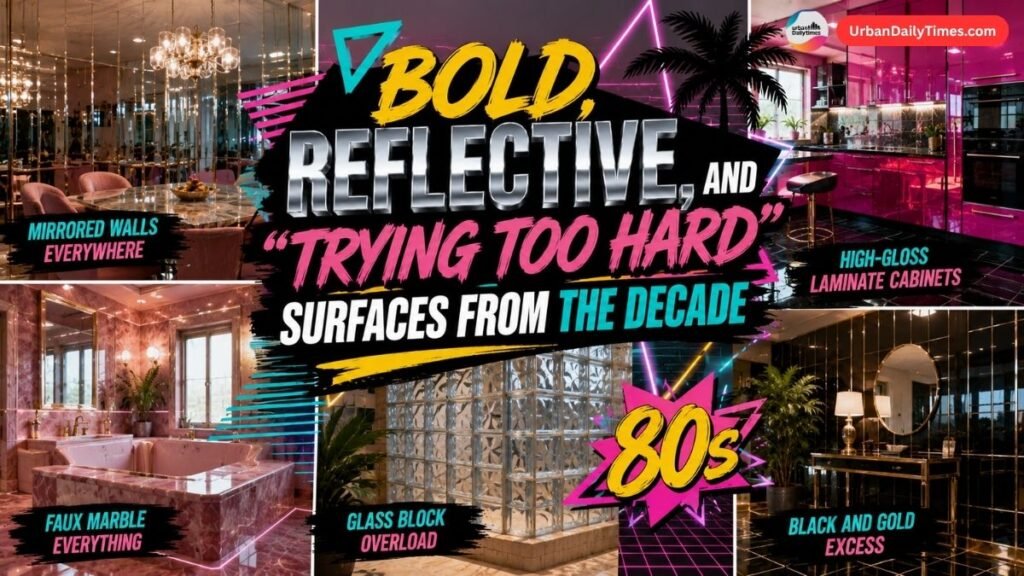
Beyond flooring, the 1980s leaned hard into reflective surfaces and glossy materials meant to signal glamour. Most of it hasn’t aged well.
Large Mirrored Accent Walls
Floor-to-ceiling mirrored surfaces were everywhere in 1980s living rooms and dining rooms, often installed directly over drywall in large unbroken panels. The intent was to expand a room visually and add light, but the execution — wall mirrors covering an entire wall, sometimes with smoked or beveled glass — reads today as a dated attempt at luxury rather than a design choice. Modern interior architects still use mirror decor, just far more selectively: a single statement mirror, mirrored trim on furniture, or a mirrored backsplash instead of an entire wall.
Glass Block Walls and Room Dividers
Glass block, sometimes called glass bricks, actually dates back to the 1880s but saw a major resurgence in the 1980s thanks in part to Miami Vice’s visual style. Builders used architectural glass blocks as a privacy wall or room divider that let light through while obscuring the view — a genuinely useful function for bathroom design and shower surround applications. The problem is almost entirely aesthetic: the thick, bubbled texture of decorative glass block reads instantly as a specific decade rather than a timeless material. Where it survives today, it tends to be in narrow, functional applications — a single privacy window — rather than an entire translucent blocks wall.
Heart-Shaped and Sunken Tubs
Bold blue, mauve, or cream heart-shaped bathtubs, often paired with tiled surrounds and mirrored walls, became a fixture in higher-end 1980s homes. They photographed dramatically but functioned poorly — awkward corners were difficult to clean, and the shape wasted usable floor space. Most designers today recommend freestanding, simple-geometry tubs instead, which read as more current and actually free up square footage in the bathroom.
Overly Coordinated (“Matchy-Matchy”) Rooms
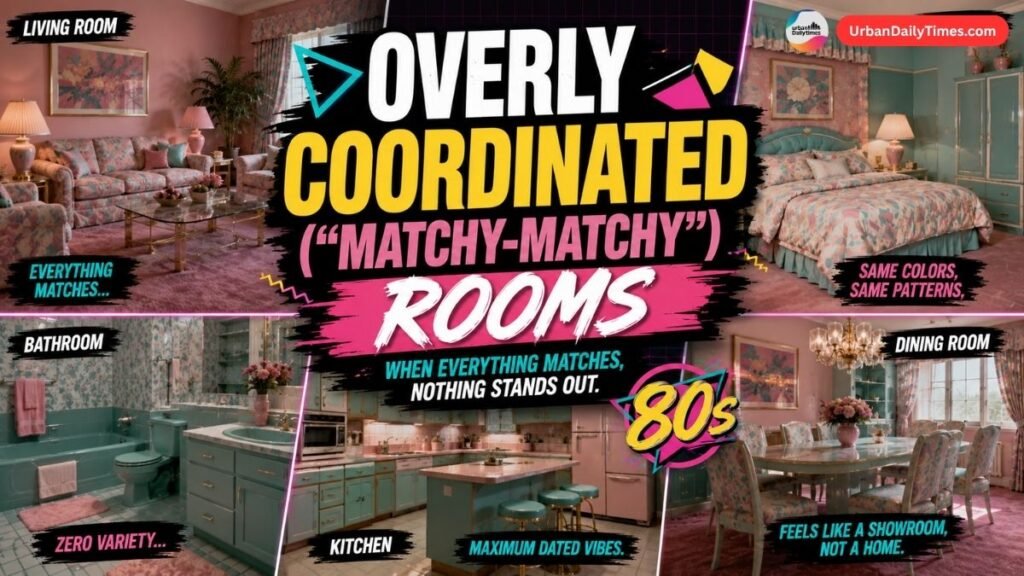
If there’s a second-place finisher behind carpet, it’s the 1980s habit of matching absolutely everything in a room.
Matching Drapery, Upholstery, and Wallpaper Sets
The decade’s signature move was buying a single fabric pattern and using it for the curtains, the upholstery, and sometimes the wallpaper in the same room — an approach that produced coordinated decor so uniform it resembled showroom style more than a lived-in home. It created visual flatness: nothing in the room stood out because everything matched everything else. Today’s interior decorating philosophy runs in the opposite direction, favoring cohesive design built from contrast and texture rather than identical furnishings.
Wallpaper Borders
Decorative wallpaper border strips, often featuring floral or seaside motifs, were a budget alternative to crown molding. Because crown molding was expensive, homeowners used printed borders instead — a workaround that has aged into one of the more dated home styles references from the decade, largely because actual millwork and molding have become far more accessible since then.
Why Designers Now Favor Curated Contrast Over Uniformity
Modern home styling treats visual balance as a mix of soft materials and hard materials, warm tones against cool ones, and old pieces against new — the opposite of the matched sets that defined 1980s residential design. A lead designer today is more likely to pair a vintage brass lamp with a contemporary sofa than to source an entire matching collection, because contrast is what makes a room feel curated and personalized rather than assembled from a single catalog page.
How to Tell If Your Home Still Has These Trends — and What to Do Instead
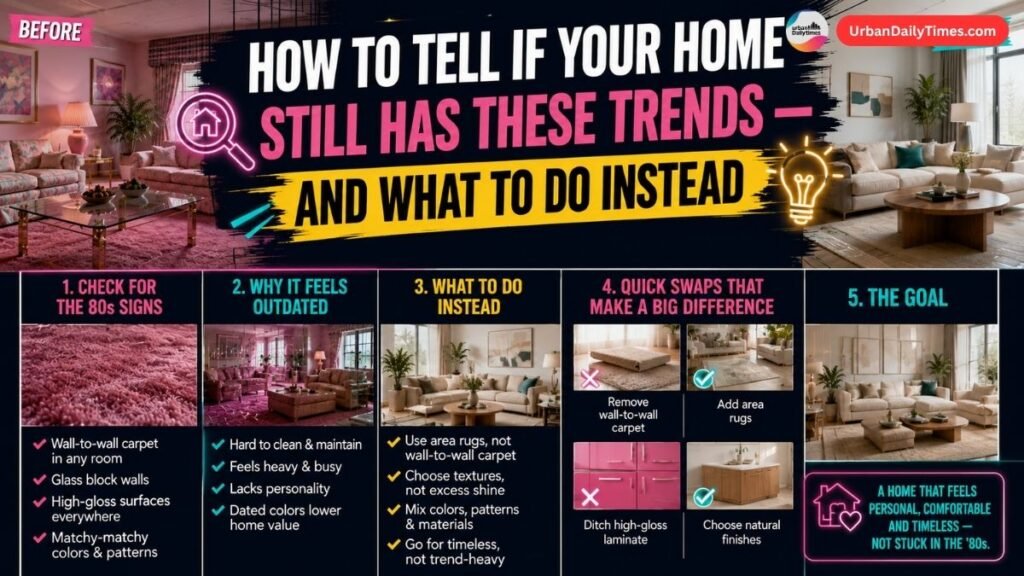
Use this quick checklist to spot lingering 1980s elements before deciding how urgently to address them.
Checklist: 1980s Trends Still Hiding in Your Home
- [ ] Wall-to-wall carpet in a bathroom or kitchen
- [ ] Popcorn texture on ceilings (get it tested for asbestos before touching it)
- [ ] A full mirrored wall in a living room or dining room
- [ ] Glass block windows or dividers used as a major design feature
- [ ] Matching drapery and upholstery fabric in the same room
- [ ] Wallpaper borders instead of molding
- [ ] Brown-speckled or heavily patterned laminate countertops
- [ ] A heart-shaped or sunken bathtub
Quick Wins
Not every fix requires a full home makeover. Some of the highest-impact, lowest-cost changes include:
- Swap wall-to-wall carpet for area rugs or layered rugs over refinished hardwood — a fraction of the cost of full flooring replacement.
- Replace a single mirrored feature wall with paint and one statement mirror instead of full coverage.
- Update furniture finishes — trade a lacquer finish or heavy chrome accents for mixed metals and matte textures.
- Remove wallpaper borders and add simple painted molding for a more timeless design look.
When It’s Worth a Bigger Renovation
Popcorn ceiling removal, full bathroom carpet replacement, and glass block wall removal generally require professional labor, especially where asbestos testing or plumbing access is involved. These are worth budgeting for as part of a broader home improvement plan rather than a weekend project, particularly if resale value is a factor — outdated flooring and dated surfaces are consistently cited by real estate professionals as items that suppress buyer interest.
Key Takeaways
- Wall-to-wall carpet, especially in bathrooms and kitchens, is the 1980s trend interior designers most consistently want left in the past, due to hygiene, maintenance, and resale concerns.
- The 1980s isn’t fully rejected — fluted surfaces, brass hardware, and bold wallpaper from the same decade are actively trending in 2026’s modern interiors.
- Glass block, full mirrored walls, and matchy-matchy coordinated rooms round out the list of ’80s choices designers avoid recreating.
- A small number of designers still defend selective, low-traffic use of fitted carpet — the objection is to overuse, not the material itself.
- Simple swaps like area rugs, mixed-metal hardware, and reduced mirror coverage can modernize a space without a full renovation.
Conclusion
The biggest 1980s trend designers want gone for good is clear: wall-to-wall carpet, especially in bathrooms and high-traffic rooms. It’s not really about carpet itself. It’s about how the ’80s used it everywhere, without thought for cleaning, moisture, or comfort. That one habit still shapes how homes are judged today.
Not every ’80s idea deserves the same fate. Brass hardware, fluted surfaces, and bold wallpaper are back, and they work well in modern homes. But mirrored walls, glass block, and matchy-matchy rooms sit close behind carpet on the list. Knowing the biggest 1980s trend designers avoid, and why, makes it easier to update your own space with confidence instead of guesswork.
Frequently Asked Questions
Is wall-to-wall carpet ever coming back in style?
In limited, intentional applications — a formal bedroom or low-traffic sitting room — some designers are experimenting with wall-to-wall carpet again. But the 1980s approach of carpeting bathrooms, kitchens, and high-traffic areas remains firmly out of favor across the design industry.
What 1980s trends are designers actually bringing back?
Fluted and reeded surfaces, brass and warm-metal hardware, bold ceiling wallpaper, and cozy maximalist color use are all resurging, according to multiple 2025-2026 designer interviews. The distinction from the original decade is restraint — these elements are used as accents, not applied to every surface in a room.
Is it worth removing popcorn ceilings before selling a house?
Many real estate professionals note that popcorn ceilings read as dated to buyers, and homes built before the early 1990s should be tested for asbestos before any removal work begins. Once cleared, smooth-ceiling conversion is a common pre-sale improvement.
Are glass block walls making a comeback anywhere?
Glass block still appears occasionally in narrow, functional roles — a single privacy window in a shower, for example — but full glass block walls or room dividers remain associated with the 1980s and are rarely used as a primary design feature in contemporary homes today.

Welcome to Urban Daily Times. My name is Malik Akmal, and I’m passionate about sharing practical home decor and home improvement ideas that help you create a better living space. With over 15 years of experience in home design, renovation trends, and product research, I focus on providing trustworthy advice that helps homeowners save money and choose the right solutions. Every product and recommendation featured on Urban Daily Times is carefully researched and reviewed to ensure you get honest, useful, and reliable information.


