
Bedroom curtain ideas cover the fabrics, colors, styles, and details you choose to dress your bedroom windows. This includes everything from soft linen panels to cottage pleat headings, floral prints, and neutral tones that shape the whole room’s mood.
Here’s something most people overlook: curtains carry more visual weight than almost anything else in a bedroom. A rug covers the floor. A headboard sits against one wall. But curtains hang tall, catch the light, and frame the entire window. Get them right, and a plain room suddenly feels finished. Get them wrong, and even a well-decorated bedroom can look unbalanced.
Good bedroom curtain ideas go beyond picking a pretty fabric. They factor in your room’s light direction, your existing colour scheme, and how much privacy or insulation you actually need. This guide breaks down colour choices, fabric types, curtain styles, and finishing touches, so you can choose curtains that work with your space and last for years, not just look good in a showroom.
Why Bedroom Curtains Matter More Than You Think
Curtains aren’t an afterthought. In a bedroom specifically, they do three jobs at once: they control light, they shape the acoustics and warmth of the room, and they’re often the single largest piece of fabric in the space, which means they carry more visual weight than a rug or a headboard.
Interior designers frequently point out that bedroom window treatments are one of the fastest ways to age or modernise a room without touching the walls. A tired floral valance can make a freshly painted bedroom look dated instantly, while a well-chosen linen panel can make a room with plain white walls feel finished and intentional.
“Curtains are the jewellery of a room. You can have a beautifully dressed bed and a lovely rug, but if the windows are wrong, the whole scheme falls flat.” — a sentiment echoed by countless professional stylists across the design industry.
What Good Bedroom Curtains Actually Do
- Block or filter light for better sleep quality
- Insulate the room, reducing heat loss in winter and heat gain in summer
- Dampen outside noise, especially with heavier or lined fabrics
- Add privacy without needing blinds or shutters
- Anchor the colour palette, tying together bedding, walls, and furniture
- Soften hard architectural lines, like square window frames or exposed radiators
Understanding Your Bedroom Scheme Before You Shop
Before you look at a single fabric swatch, take stock of what’s already in the room. Your curtains need to work with your bedroom scheme, not fight it. That means considering your wall colour, flooring, existing furniture finishes, and the amount of natural light the room gets.
A north-facing bedroom that gets cool, flat light all day behaves very differently to a south-facing room flooded with warm afternoon sun. Neutral fabrics can look almost grey in a cold-light room, while the same fabric might look warm and inviting in a sunnier space. Always view fabric samples in your actual room, at different times of day, before committing.
Questions to Ask Before Choosing Fabric
- What direction does the window face, and how much natural light comes in?
- Do I want the room fully dark for sleep, or softly lit?
- What’s the dominant tone of my existing furniture — warm wood, cool grey, black metal?
- Is the window a focal point, or should the curtains recede into the background?
- Do I need noise reduction, insulation, or both?
Getting these answers straight first will save you from buying beautiful curtains that simply don’t belong in the room.
Choosing a Colour Scheme for Bedroom Curtains
Colour is usually the first decision people make, and it’s the one with the most lasting impact. Your curtain ideas should always start with a clear sense of the colour palette you’re building, whether that’s calm and monochromatic or layered with contrast.
Neutral and Muted Tones
Neutral colours remain the most popular choice for bedrooms, and for good reason. Neutral curtains in tones like oatmeal, dove grey, soft taupe, or warm white blend easily with almost any bedroom colors, making them a safe long-term investment if you like to change accessories or bedding frequently.
Muted tones and muted fabrics — think dusty pink, sage green, or soft clay — offer a middle ground between stark neutrals and bold statement colour. They add warmth and personality without overwhelming a small or light-filled room.
Bold Shades
If your walls and furniture are already neutral, bold shades on the window can be the single element that gives a bedroom its character. Deep forest green, burnt terracotta, or navy window treatments work particularly well in rooms with high ceilings or large windows, where there’s enough fabric to make the colour feel intentional rather than overpowering.
| Colour Approach | Best For | Things to Consider |
|---|---|---|
| Neutral curtains | Small bedrooms, rental properties, resale value | Can feel flat without added texture |
| Muted tones | Calm, restful bedrooms, cottage or coastal schemes | Choose fabrics with slight texture to avoid a washed-out look |
| Bold shades | Statement rooms, large windows, minimalist schemes | Test in the room’s actual light before committing to yardage |
| Patterned curtains | Rooms that need visual interest | Keep bedding and walls simpler to balance the pattern |
Coordinating Curtains With the Rest of the Room
Matching curtains to your interior scheme doesn’t mean everything needs to be the exact same colour. A cohesive look usually comes from repeating two or three tones throughout the room — perhaps the curtain fabric echoes a colour in the rug, and the trim picks up a shade from a cushion. This creates coordinated curtains without the room feeling matchy or flat.
Complementary fabrics are especially useful when you’re mixing patterns. A small-scale check on a cushion, paired with a larger floral print on the curtain, works because the scale of the patterns differs while the colour palette stays consistent.
Curtain Ideas by Fabric Type
Fabric choice affects everything from how the curtain hangs to how much light it blocks. Here’s a breakdown of the most common natural textiles and blends used for bedroom drapes.
Linen Curtains
Linen curtains are a favourite for good reason. Linen has a relaxed, slightly textured drape that suits both modern and traditional bedrooms. It’s breathable, which makes it a genuinely sleep-friendly choice in warmer climates, though unlined linen alone won’t block much light.
Pros of linen curtains:
- Naturally textured, adds visual interest without pattern
- Breathable and suited to warmer rooms
- Ages gracefully, softening with wash and wear
Cons of linen curtains:
- Wrinkles easily, especially unlined
- Needs lining for proper blackout or insulation
- Can be pricier than synthetic blends
Soft and Natural Textiles
Beyond linen, soft fabrics like cotton velvet, brushed cotton, and wool blends are popular in bedrooms because of how they feel and how they behave acoustically. Heavier natural textiles absorb sound better than lightweight sheers, which matters if your bedroom faces a busy street.
Sheer and Layered Window Dressing
Many bedrooms benefit from a layered approach: a sheer panel closest to the glass for daytime privacy and light diffusion, paired with a heavier curtain panel for night-time blackout. This layered window dressing approach gives you flexibility throughout the day without needing to swap fabrics or install blinds separately.
Popular Bedroom Curtain Styles
Once colour and fabric are settled, style and heading type shape how the curtain actually hangs and moves. This is where curtain design ideas really start to differentiate one bedroom from another.
Cottage Pleat Curtains
Cottage pleat curtains are a softly gathered heading style that sits between a relaxed pencil pleat and a more structured pinch pleat. They create gentle, informal folds that suit cottage-style curtains and country-inspired bedrooms particularly well. This style pairs beautifully with floral curtains, ticking stripes, and other nature-inspired fabric, giving the window a homely, unfussy character.
Pleated and Gathered Curtains
Pleated curtains, including triple pinch pleat and goblet pleat headings, create a more tailored, formal look. Gathered curtains on a simple slot or tab heading feel more casual and are often used in smaller or more relaxed bedrooms.
| Curtain Style | Look | Best Suited To |
|---|---|---|
| Cottage pleat curtains | Soft, informal gathers | Country, coastal, and cottage-style bedrooms |
| Pinch pleat | Structured, tailored folds | Formal or traditional bedrooms |
| Eyelet/ring top | Clean, modern lines | Contemporary and minimalist bedrooms |
| Ruffle curtains | Romantic, layered edges | Feminine or vintage-inspired schemes |
| Wave heading | Smooth, continuous waves | Modern and Scandinavian-style rooms |
Traditional Drapes and Statement Curtains
Traditional drapes with fuller headings and floor-pooling lengths suit period properties and larger bedrooms with high ceilings. They read as more formal and often work best with tiebacks and coordinating pelmets.
Floral and Pattern-Based Curtain Ideas
A floral print remains one of the most enduring curtain ideas for bedrooms, and it’s easy to see why. Botanical patterns bring warmth, softness, and a connection to nature that solid fabrics can’t replicate on their own.
Choosing the Right Scale of Floral Design
Small, ditsy floral designs suit smaller bedrooms or rooms where you want a subtle pattern that reads almost as texture from a distance. Large-scale, statement garden-inspired decor works well on generous windows and in bedrooms where the curtain is meant to be the focal point.
Tips for using floral curtains successfully:
- Keep the wall colour simple if the floral pattern is bold or large-scale
- Pull one accent colour from the print into cushions or a throw
- Balance a busy floral print with plain bedding rather than another pattern
- Consider a nature-inspired fabric with muted, tonal florals for a more grown-up look than bright, high-contrast prints
Made-to-Measure vs Off-the-Shelf Curtains
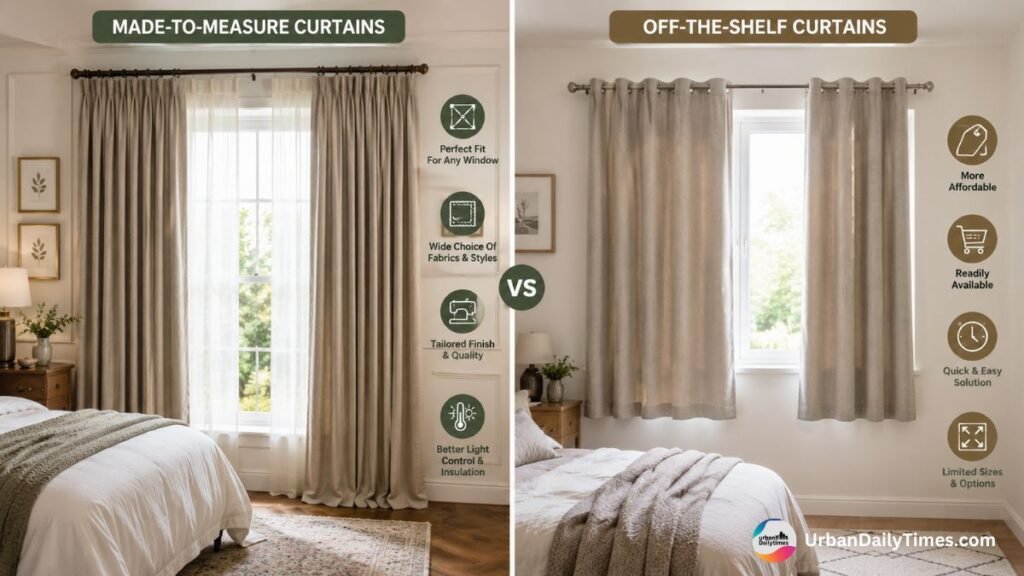
This is one of the most practical decisions in the whole process, and it affects both budget and finish quality.
Made-to-Measure Curtains
Made-to-measure curtains, sometimes called bespoke drapes or tailored curtains, are cut and sewn to the exact dimensions of your window. Custom curtains allow full control over fabric, lining, heading style, and length, and they avoid the awkward pooling or hovering hem you get from standard, off-the-shelf sizes.
Custom-made curtains are particularly worth the investment for:
- Non-standard window sizes (very tall, very wide, bay windows)
- Statement fabrics where fit needs to be precise
- Rooms where blackout or thermal lining is essential
- Long-term homes where you want the curtains to last
Ready-Made Curtains
Off-the-shelf fitted window treatments are more budget-friendly and widely available, but sizing is limited to standard drops and widths. They work well for standard window sizes, rental properties, or when you want to update a room’s look without a major spend.
| Factor | Made-to-Measure | Ready-Made |
|---|---|---|
| Fit | Precise, custom | Standard sizes only |
| Fabric choice | Extensive | Limited to stocked options |
| Cost | Higher | Lower |
| Lead time | Weeks | Immediate |
| Best for | Statement windows, long-term homes | Rentals, quick updates |
Decorative Details That Elevate Bedroom Curtains
The finishing touches often make the biggest visual difference, and they’re the easiest part of the process to overlook.
Trims, Tapes, and Embellishments
Trims and tapes — contrast borders, braid, pom-pom edging, or a simple contrast binding — turn a plain curtain into something that looks properly designed. Curtain embellishments like these are especially effective on solid-coloured neutral fabrics, where the trim becomes the main source of visual interest.
Decorative drapery details worth considering:
- Contrast trim along the leading edge or hem
- Ornamental details like tasselled tiebacks
- Curtain accessories such as decorative poles, finials, and holdbacks
- Coordinating decorative details with cushion trims or lampshade edging for a pulled-together look
Hardware Matters Too
The pole or track you choose affects the overall style as much as the fabric. A slim black metal pole suits modern window coverings, while a wooden pole with a simple finial complements cottage-style curtains and traditional schemes.
Step-by-Step Guide to Choosing Bedroom Curtains
- Assess the room — note light direction, existing colours, and window size.
- Set a goal — decide if you need blackout, insulation, or purely decorative window dressing ideas.
- Pick a colour direction — neutral, muted, or bold, based on your existing bedroom decor.
- Choose your fabric — linen, cotton, velvet, or blends, based on light and climate needs.
- Select a heading style — cottage pleat curtains, pinch pleat, eyelet, or wave.
- Decide on lining — standard, thermal, or blackout lining.
- Choose made-to-measure or ready-made based on your window size and budget.
- Add decorative details — trims, tiebacks, or statement hardware.
- Order swatches first — always view fabric in your room before buying full yardage.
- Measure twice — confirm width and drop before finalising your order.
Common Mistakes to Avoid
- Buying curtains too short. Curtains that stop above the windowsill or float mid-wall almost always look unfinished. Floor-length or a gentle break at the floor tends to look more polished.
- Skipping the lining. Even decorative curtains benefit from lining, which improves drape, protects fabric from sun fading, and adds a more substantial look.
- Choosing pattern before considering the whole room. A stunning floral print can clash badly if chosen before you’ve settled on wall colour and bedding.
- Underestimating fabric quantity. Skimpy, flat panels rarely look as good as generously gathered curtains — aim for at least double the track width in fabric.
- Ignoring the hardware. A beautiful fabric on a cheap, sagging track undermines the whole effect.
Real-World Example: A Small North-Facing Bedroom
Consider a common scenario: a small, north-facing bedroom with cool, flat daylight and pale grey walls. The homeowner initially chose a crisp white linen curtain, but in the room’s cooler light, it read as clinical rather than calming.
Switching to a warm, muted dusty-rose linen curtain with a soft cottage pleat heading changed the entire feel of the room. The warmer tone balanced the cool light, the gentle pleat softened the window’s sharp lines, and a simple contrast trim in a deeper rose tied the curtains back to the room’s cushions. The lesson here is a common one among designers: colour temperature matters as much as colour itself, and it should always be tested in the actual room before a final decision is made.
Key Takeaways
- Start with your existing bedroom scheme, not the fabric shop shelf
- Neutral fabrics and muted tones offer the most long-term flexibility
- Cottage pleat curtains and floral print fabrics suit relaxed, cottage-inspired bedrooms
- Made-to-measure curtains are worth it for non-standard windows or statement fabrics
- Decorative details like trims and quality hardware make a noticeable difference
- Always test fabric swatches in your actual room before committing to yardage
Choosing bedroom curtains doesn’t need to be overwhelming once you break it down into colour, fabric, style, and finishing details. Take your time with swatches, trust how the room actually looks at different times of day, and remember that the goal isn’t just a beautiful window — it’s a bedroom that feels calm, cohesive, and genuinely restful to spend time in.
Conclusion
Great bedroom curtain ideas always start with your room, not the fabric shop. Look at your light, your colours, and your furniture first. Then pick a fabric and style that fit that scheme. Neutral tones offer flexibility. Bold shades add character. Cottage pleats and soft florals bring warmth. Small choices, like trims and hardware, complete the look.
The best bedroom curtain ideas balance beauty with function. Your curtains should block light well, feel right for your climate, and match your room’s mood. Test swatches before you buy. Measure your window twice. Choose made-to-measure curtains for a precise fit when it matters. Get these basics right, and your bedroom will feel calm, finished, and truly your own.
Frequently Asked Questions
What is the best fabric for bedroom curtains?
There’s no single best fabric — it depends on your priorities. Linen curtains suit warmer climates and relaxed schemes, while heavier cotton or velvet blends are better for noise reduction and insulation in colder rooms.
Should bedroom curtains touch the floor?
Yes, in most cases. Curtains that just brush the floor or break slightly onto it look more considered than curtains that stop short of the sill or hover above the floor.
Are cottage pleat curtains only for country-style bedrooms?
Not necessarily. While cottage pleat curtains are strongly associated with country and cottage interiors, the soft, informal gather also works well in coastal, Scandinavian, and relaxed contemporary bedrooms when paired with simpler, more neutral fabrics.
Is it worth paying for made-to-measure curtains?
If your window is a standard size and budget is tight, ready-made curtains can work well. But for non-standard windows, statement fabrics, or curtains you plan to keep for years, made-to-measure curtains typically offer better fit, better fabric choice, and a more finished result.
How do I choose a colour scheme for bedroom curtains?
Start with what’s already fixed in the room — flooring, wall colour, and major furniture pieces. Choose a curtain colour that either blends with this colour scheme for a calm look, or provides deliberate contrast for a statement look. Testing swatches in the room at different times of day is the most reliable way to confirm your choice.

Welcome to Urban Daily Times. My name is Malik Akmal, and I’m passionate about sharing practical home decor and home improvement ideas that help you create a better living space. With over 15 years of experience in home design, renovation trends, and product research, I focus on providing trustworthy advice that helps homeowners save money and choose the right solutions. Every product and recommendation featured on Urban Daily Times is carefully researched and reviewed to ensure you get honest, useful, and reliable information.


