
Walk into two homes with identical furniture, and one will feel like a page torn from a magazine while the other feels flat and unfinished. The difference almost never comes down to money. It comes down to styling.
Interior styling is the art of arranging what you already own — and a few carefully chosen extras — so that a room feels intentional, layered, and alive. It’s the final 10% of a space that somehow makes 100% of the difference: the way books are stacked, the way a throw is folded over an armchair, the way three ceramic vases of different heights sit together on a shelf instead of standing alone.
This guide breaks down exactly what interior styling means, how it differs from interior design, which rooms benefit most from it, and how you can start styling your own home today — no professional qualification required. Along the way, you’ll find real styling techniques for sofas, shelves, bathrooms, bedrooms, coffee tables, kitchens, and more, plus advice inspired by some of the industry’s best-known names, including maximalist design authority Abigail Ahern.
Whether you’ve just moved into a new place, you’re refreshing a home you’ve lived in for years, or you’re simply trying to work out why your living room never quite feels “finished,” this guide is designed to give you a practical, room-by-room framework. You don’t need a design degree, an unlimited budget, or a professional stylist on speed dial. You need a clear understanding of a handful of repeatable techniques — and the confidence to apply them to your own space, in your own way.
Interior Styling Advice from Abigail Ahern
Few names come up as often in conversations about home styling as Abigail Ahern. The British designer, author, and television judge has spent over two decades encouraging homeowners to abandon rigid decorating rules in favour of instinct, personality, and layering.
Her core philosophy is refreshingly simple: a home should feel like an extension of the people who live in it, not a showroom that follows whatever is currently trending. A few of her most repeated pieces of advice include:
- Don’t be afraid of colour. She considers a bold colour choice one of the most cost-effective ways to transform a room, since paint is inexpensive relative to the impact it delivers.
- Scale up your lighting. Rather than relying on one central ceiling fixture, she recommends layering multiple lamps throughout a room to build atmosphere, warmth, and depth.
- Mix your textures deliberately. If a sofa is upholstered in velvet, she suggests pairing it with cushions in wool, linen, or leather rather than more velvet, because contrasting textures create visual friction that makes a space feel considered rather than flat.
- Break the “matching ceiling and trim” rule. One of her more unconventional recommendations is painting the ceiling, walls, and trim the same tone so that the architecture recedes and the furniture and accessories become the focal point.
- Layer, don’t decorate in isolation. Objects should be grouped, stacked, and displayed in clusters rather than dotted individually around a room, since repetition and grouping is what reads as “styled” to the eye.
The common thread running through her approach is permission — permission to break so-called design rules, to decorate from instinct rather than trend, and to build a home that feels personal rather than formulaic. That mindset is a useful starting point for anyone learning to style their own space, whether your taste leans maximalist or minimalist.
What is the difference between Interior Styling and Interior Design?
These two terms get used interchangeably all the time, but they describe two very different disciplines. Understanding the distinction will help you figure out exactly what your home actually needs.
Interior Styling
Interior styling is the finishing layer. It’s a cosmetic, often temporary process that focuses on how a space looks and feels once the structural and furniture decisions have already been made. Styling deals with:
- Arranging accessories, books, cushions, and décor objects
- Curating colour palettes and textures within an existing layout
- Creating vignettes on shelves, tables, and mantels
- Refreshing a room seasonally without major spending
- Preparing a home for photography or sale (“staging”)
A stylist typically works with what’s already in the room, or introduces a small number of new pieces, to elevate the overall look. It’s fast, flexible, and doesn’t usually require construction, planning permission, or a large budget.
Interior design
Interior design is the structural and functional foundation that styling sits on top of. It’s a longer-term, more technical process that often begins before a single accessory is chosen. Interior design deals with:
- Floor plans, room layout, and spatial flow
- Structural changes such as knocking down walls or adding windows
- Selecting flooring, cabinetry, plumbing fixtures, and built-in storage
- Lighting plans and electrical positioning
- Furniture selection based on scale, ergonomics, and function
An interior designer is typically trained in space planning and building requirements, and a design project can take months or years to complete. Styling, by comparison, can transform a room in an afternoon.
| Aspect | Interior Styling | Interior Design |
|---|---|---|
| Focus | Aesthetics, accessories, arrangement | Layout, structure, function |
| Timeline | Hours to days | Weeks to months |
| Budget | Low to moderate | Moderate to high |
| Permanence | Often temporary/flexible | Usually permanent |
| Typical tasks | Styling shelves, tables, textiles | Floor plans, renovations, fixed finishes |
| Who does it | Stylists, homeowners, DIYers | Trained/qualified interior designers |
In short: design decides what goes where and why it works structurally, while styling decides how it all comes together visually. The best-looking homes usually benefit from both, but styling is by far the more accessible entry point for most homeowners.
Can Anyone Style their Home or Do You Need an Interior Stylist?
The honest answer is that anyone can learn to style their home. Styling is a skill built on observation and repetition, not an innate talent reserved for professionals. That said, there are situations where each approach makes more sense.
You can likely style your own home if:
- You’re working with an existing layout and furniture you like
- You enjoy shopping for homeware and have an eye for colour and texture
- You have time to experiment, step back, and adjust
- Your budget is limited and you want to use what you already own
You might benefit from hiring an interior stylist if:
- You’re preparing a property for sale or a rental listing and need it “market-ready” fast
- You have a specific event, photoshoot, or launch with a tight deadline
- You’ve tried styling a space yourself and it still feels “off” but you can’t identify why
- You want a completely fresh look without spending weeks researching and shopping
A professional stylist brings a trained eye, industry connections to suppliers, and an outside perspective that’s hard to develop about your own home. But for everyday living spaces, most of the principles a stylist uses — grouping objects in odd numbers, varying height, layering texture, editing out clutter — can be learned and applied by anyone willing to practise. Think of professional styling as a shortcut, not a requirement.
Which Areas of the Home Can You Style?
Genuinely, every room and surface in your home can be styled — some just respond more dramatically than others. Here’s a breakdown of the areas that benefit most:
- Living room: sofas, coffee tables, console tables, bookshelves, mantelpieces, and gallery walls
- Bedroom: the bed itself, nightstands, dressers, and reading corners
- Kitchen: open shelving, countertops, kitchen islands, and breakfast nooks
- Bathroom: vanities, shelving, bath caddies, and windowsills
- Entryway/hallway: console tables, mirrors, coat hooks, and shoe storage
- Dining room: the dining table itself, sideboards, and buffet units
- Home office: desks, floating shelves, and pinboards
- Outdoor spaces: patios, balconies, and garden seating areas
Not every area needs the same level of attention. High-traffic, high-visibility spots — entryways, coffee tables, open shelving — offer the biggest visual return for the smallest effort, which makes them the best place to start if you’re new to styling.
It’s also worth thinking about your home in terms of “zones” rather than isolated rooms. A hallway that leads into a living room should feel like part of the same visual story, not a completely separate style. Repeating a colour, material, or object type — such as brass hardware or a particular shade of green — as you move from one space into the next helps a whole home feel considered, rather than a series of disconnected rooms that were each styled in isolation.
What are the Key Interior Styling essentials?
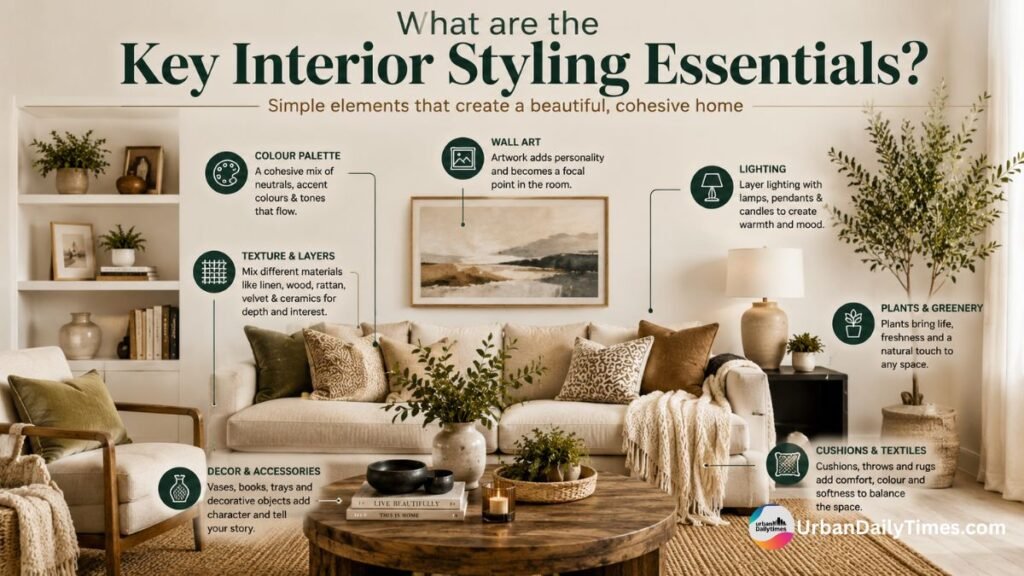
Regardless of which room you’re working on, professional stylists tend to lean on the same handful of principles again and again. Once you understand these, you can apply them almost anywhere in your home.
- Height variation. Group objects of different heights together rather than lining up items that are all the same size. A tall vase, a medium stack of books, and a small trinket dish instantly look more curated than three identical candles in a row.
- The rule of odd numbers. Groupings of three or five generally feel more natural and balanced to the eye than pairs or even numbers.
- Texture contrast. Mixing matte and glossy, rough and smooth, soft and hard materials adds depth. A ceramic bowl next to a woven basket next to a smooth glass vase reads as intentional.
- Colour cohesion. Pick a palette — whether that’s neutral tones, a single accent colour in different shades, or a considered mix — and repeat it in small doses throughout the space so the eye has somewhere consistent to land.
- Layering. Nothing should sit completely alone. Rugs go under furniture, cushions overlap on a sofa, books sit under objects rather than beside them.
- Negative space. Styling isn’t about filling every surface. Leaving intentional empty space allows the eye to rest and stops a room from feeling cluttered.
- Personal objects. The most memorable, “put-together” spaces almost always include something personal — a travel souvenir, an inherited object, a piece of art you love — mixed in among the more generic décor.
- Scale awareness. Oversized lamps, large-scale art, and statement mirrors tend to make a bigger design impact than lots of small, scattered accessories.
Keep these eight principles in mind and you’ll find yourself instinctively improving almost any surface in your home.
To make these principles easier to apply in practice, here’s a quick-reference table showing how each one translates into a real, everyday action:
| Styling Essential | What It Looks Like in Practice |
|---|---|
| Height variation | Pair a tall lamp with a mid-height stack of books and a small dish |
| Odd numbers | Group three candles instead of two, or five cushions instead of four |
| Texture contrast | Combine a woven basket, a smooth ceramic vase, and a linen throw |
| Colour cohesion | Repeat one accent colour across cushions, art, and accessories |
| Layering | Overlap a rug, a coffee table tray, and a stack of books |
| Negative space | Leave one third of a shelf or table intentionally empty |
| Personal objects | Display a travel find or family heirloom alongside newer décor |
| Scale awareness | Choose one oversized item, such as a large mirror, per room |
These principles aren’t meant to be applied rigidly or all at once. Most experienced stylists treat them as a checklist to return to after an initial arrangement, using them to spot what’s missing rather than as a strict formula to follow from the very first step.
Can you Style Your Outdoor Space in the same way?
Yes — outdoor styling follows exactly the same principles as indoor styling, just adapted for weather-resistant materials and open-air layouts. A patio, balcony, or garden seating area benefits from the same layering, grouping, and texture-mixing techniques used indoors.
Ways to bring interior styling logic outside include:
- Layering outdoor rugs under seating areas to define a “room” within the garden
- Grouping planters of varying heights instead of lining them up evenly
- Adding outdoor cushions and throws in weather-resistant fabrics to soften hard furniture
- Using lanterns, string lights, or solar lamps to replicate the layered lighting effect used indoors
- Styling a small outdoor table with a tray, a candle, and a plant, just as you would a coffee table inside
- Mixing planting textures — trailing ivy, upright grasses, broad-leafed plants — the same way you’d mix textures on a shelf
The main difference is material selection: outdoor styling requires UV-resistant fabrics, weatherproof finishes, and drainage-friendly planters. But the visual logic — height variation, grouping, colour repetition — transfers directly from indoors to out.
Interior Styling Visuals: Examples and Inspiration
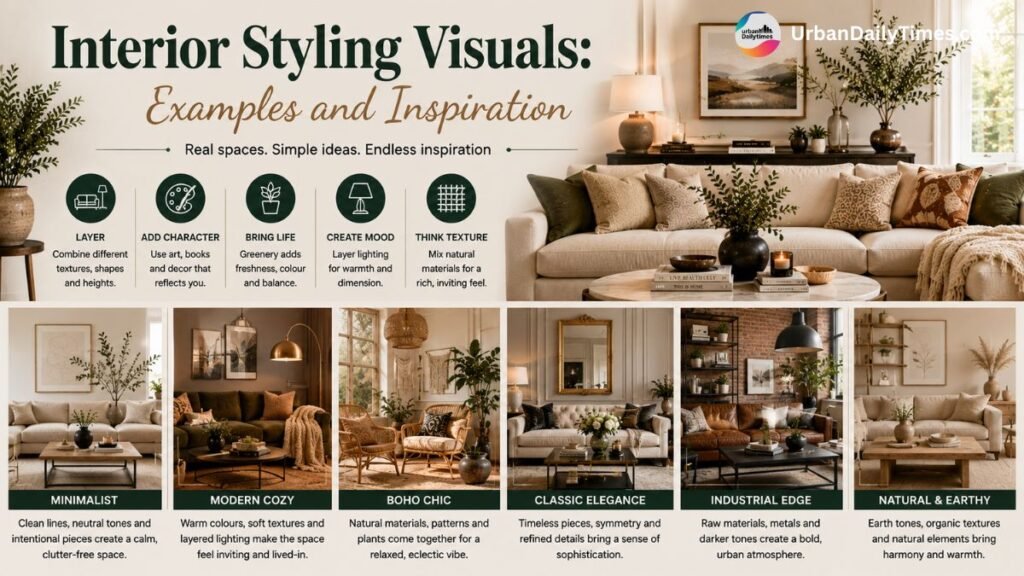
Seeing styling principles applied to specific areas of the home makes them far easier to replicate. Below is a room-by-room and surface-by-surface breakdown of how professional stylists approach some of the most commonly styled spots in a house.
Styling a Sofa for a More Put-Together Living Room
A sofa is one of the biggest pieces of furniture in most living rooms, and an unstyled one can make an entire room feel unfinished. To style a sofa well:
- Use an odd number of cushions — five or seven tends to look more relaxed than an even, overly symmetrical arrangement
- Mix cushion sizes and textures rather than buying a matching set
- Add one patterned or textured cushion as a focal point, then build supporting neutral tones around it
- Drape a throw casually over one arm, folded loosely rather than perfectly flat
- Leave one end of the sofa slightly less “full” than the other to avoid a stiff, showroom-like symmetry
Curated Shelves for a Professionally-Styled, Layered Look
Bookshelves and floating shelves are one of the easiest places to practise styling because they’re low-cost and endlessly adjustable. Try this approach:
- Group books both vertically and stacked horizontally, rather than lining every spine upright
- Use stacked books as a “riser” underneath small objects like candles or bud vases
- Alternate negative space with fuller sections so the shelf breathes
- Introduce one or two plants to soften the hard lines of books and frames
- Repeat a colour or material (such as brass or ceramic) across two or three shelves to tie the whole unit together
Bathroom Styling for a Calm, Considered Space
Bathrooms are functional by nature, but a few styling touches make them feel like a retreat rather than a purely utilitarian space:
- Swap plastic bottles for matching refillable dispensers in glass or ceramic
- Roll towels instead of folding them flat, and stack in odd numbers on open shelving
- Add a small plant that tolerates humidity, such as a fern or peace lily
- Use a wooden tray on the vanity or bath edge to corral everyday items into one tidy zone
- Introduce one textured element — a woven basket, stone soap dish, or linen bath mat — to soften hard tile and glass surfaces
Dressing the Bed for a Relaxed, Layered Look
The bed is the visual anchor of any bedroom, and layering is the single most important technique here:
- Start with a fitted sheet and flat sheet, then add a duvet in a complementary but not identical tone
- Layer a lightweight throw or quilt across the foot of the bed for texture
- Use pillows in at least two sizes — standard sleeping pillows plus one or two decorative Euro shams
- Mix pillow textures, such as a linen sham with a velvet lumbar cushion
- Fold the throw slightly off-centre rather than perfectly straight, to keep the look relaxed rather than stiff
Coffee Table and Mantlepiece Styling Ideas
Both surfaces work on the same principle: create a small, intentional vignette rather than scattering random objects.
- Anchor the arrangement with one larger item — a tray, a stack of books, or a sculptural object
- Add a plant or flowers for organic softness
- Include one object with personal meaning or a story behind it
- Keep a portion of the surface empty so the grouping doesn’t feel crowded
- On a mantel specifically, lean a piece of art or a mirror against the wall rather than hanging it, and layer smaller objects in front
Styling with Pattern for a More Dynamic Space
Pattern adds energy to a room, but it needs a system to avoid looking chaotic:
- Choose one dominant pattern (such as a large floral or geometric print) as the star
- Support it with one or two smaller-scale patterns in a complementary colourway
- Balance patterned pieces with solid, neutral surfaces so the eye has somewhere to rest
- Repeat at least one colour from the pattern elsewhere in the room to tie everything together
- Use patterned textiles — cushions, rugs, curtains — rather than patterned furniture if you’re new to mixing prints, since textiles are easier and cheaper to change later
A Stylish Side Table with Thoughtful Details
A side table is small, but it’s often at eye level when seated, which makes it worth styling carefully:
- Limit the arrangement to two or three objects maximum
- Include a small lamp for both function and warmth
- Add one object with texture, such as a small ceramic dish or wooden bowl
- Leave a coaster or small tray out to keep the surface practical as well as pretty
A Styled Vignette in the Kitchen
Kitchens can absolutely be styled without compromising function:
- Group a few frequently used items — olive oil, a wooden spoon holder, a small plant — near the stove for a lived-in, editorial look
- Use a wooden chopping board propped upright as a textural backdrop for smaller objects
- Swap open storage jars for a matching set in glass or ceramic
- Add fresh produce, such as a bowl of lemons or a bunch of herbs, for natural colour and life
Styling with a Single Colour in Different Tones
Monochromatic styling is one of the easiest techniques for beginners because it removes the guesswork around colour matching:
- Choose one base colour (such as terracotta, sage, or navy)
- Source objects in three or four different tonal shades of that colour, from pale to deep
- Vary the materials — ceramic, glass, textile, wood — so the grouping doesn’t feel one-dimensional despite the single colour
- Add one neutral element, such as a plain white vase or natural wood tray, to give the eye a resting point
Console Table Styling for an Elegant Entryway
The console table is often the first thing guests see, so it sets the tone for the whole home:
- Anchor one side with a lamp or a tall vase for height
- Add a mirror or art above the table to draw the eye upward
- Include a tray for keys and everyday items so the surface stays functional
- Balance the composition asymmetrically rather than centring everything, which tends to look more natural and less staged
Kitchen and Shelving Styling
Open kitchen shelving is having a long moment in interior styling circles because it turns everyday cookware into decoration:
- Stack plates and bowls by size and colour, from largest at the bottom to smallest at the top
- Mix in a few non-kitchen objects, such as a small plant or a piece of art, to break up rows of dishware
- Group glassware together rather than scattering it across multiple shelves
- Keep the most-used items on lower, more accessible shelves and reserve the top shelf for display pieces
Styling a Dining Table
An everyday dining table doesn’t need to be set for a dinner party to look styled:
- Use a table runner instead of a full tablecloth for a more relaxed, layered look
- Add a low, wide centrepiece — such as a bowl of fruit or a low floral arrangement — so sightlines across the table aren’t blocked
- Include textured placemats, even when the table isn’t set for a meal, to give the surface a “ready to gather” feeling
- Add one or two low candles for warmth without overwhelming the table’s height balance
Interior Elements to Bring Into Your Home
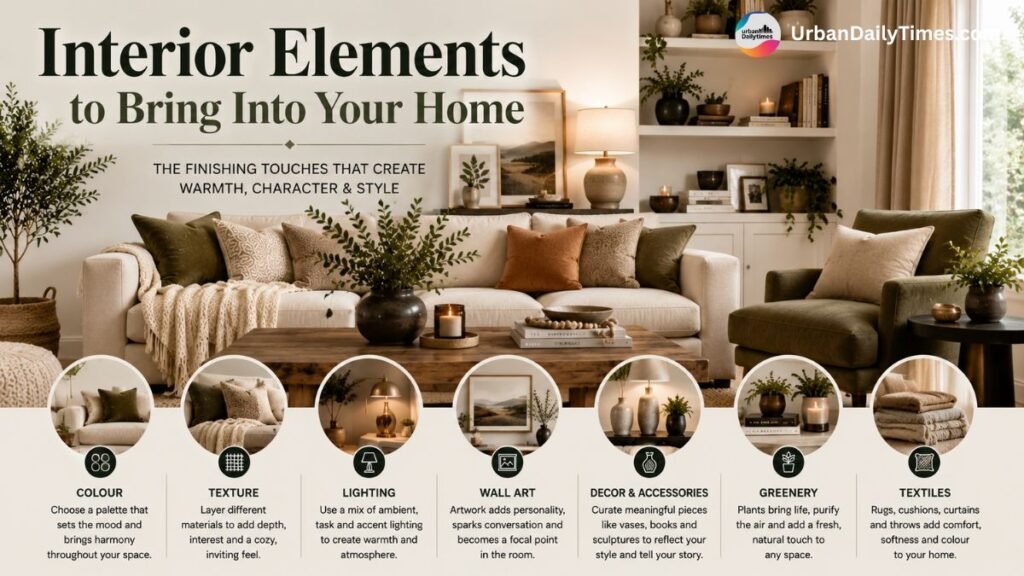
If you’re starting your styling journey from scratch, a handful of key elements tend to deliver the most visual impact across almost any room:
- Layered lighting: a mix of ceiling, table, and floor lighting rather than a single overhead source
- Natural materials: wood, rattan, linen, and stone bring warmth and texture that synthetic materials often lack
- Greenery: even a single well-placed plant softens hard edges and adds life to a room
- Textiles: rugs, cushions, and throws are the fastest, most affordable way to change the feel of a space
- Art and mirrors: these add personality and, in the case of mirrors, help bounce light around smaller rooms
- Vintage or one-of-a-kind pieces: a single unique object often does more for a room’s character than several mass-produced items combined
- Trays and boxes: useful for corralling smaller items into neat, intentional groupings rather than scattered clutter
- Books: beyond their practical use, books are one of the most versatile styling tools for adding height, colour, and texture to shelves and tables
Bringing even three or four of these elements into a room consistently will noticeably elevate how finished it feels.
It helps to think of these elements as a toolkit rather than a checklist you need to tick off in every single room. A small home office, for example, might only need layered lighting, one plant, and a single vintage find to feel styled, while a larger living room might comfortably use all eight elements across different surfaces. The goal isn’t to include everything everywhere — it’s to choose the elements that suit the function and scale of each specific space, then apply them consistently enough that the whole home feels like it belongs together.
My Styling Experience
Styling a home is rarely a one-and-done process — it’s closer to an ongoing conversation with the space. In practice, the rooms that end up looking the most effortless are almost always the ones that were rearranged several times before landing in their final form. A shelf that looks “curated” on the first attempt is the exception, not the rule.
The most common mistake beginners make isn’t a lack of taste — it’s rushing to fill every surface at once instead of stepping back, living with a space for a few days, and adjusting gradually. Some of the most useful lessons learned through hands-on styling include:
- Editing down is almost always more effective than adding more. Removing two or three items from an overcrowded shelf often does more for the overall look than buying something new.
- Natural light changes everything. A styled vignette that looks perfect in the afternoon can look completely different under evening lamplight, so it’s worth checking a room at different times of day.
- Cheap and expensive pieces can sit side by side without anyone noticing, as long as the colour palette and texture mix feel cohesive.
- The “final touch” — a candle, a plant, a stack of books — is often what separates a room that looks decorated from one that looks styled.
- Styling isn’t static. Swapping cushions, rotating accessories seasonally, and refreshing a coffee table vignette every few months keeps a home feeling current without a full redecorate.
Another lesson that only really becomes clear through repeated practice is that styling is highly personal, and that’s precisely the point. Two people can be given the exact same sofa, shelf, and set of accessories, and produce two completely different — yet equally successful — results. There’s no single “correct” arrangement, only one that feels balanced and true to the person living with it. That’s part of why copying a styled room exactly, down to every object, rarely feels as satisfying as adapting the same underlying principles to pieces you already love.
It’s also worth acknowledging that not every attempt works on the first try, and that’s completely normal. A shelf that looks cluttered one week might just need one object removed. A coffee table that feels sparse might need one more layer of texture. Treating styling as an iterative process, rather than a single event you either get right or wrong, removes a lot of the pressure and makes the whole process far more enjoyable.
Where do you find inspiration for Interior Styling?
Inspiration is everywhere once you start looking for it with a stylist’s eye. Some of the most useful sources include:
- Interior design magazines and books, which tend to feature professionally styled shoots with intentional, high-impact arrangements
- Show homes and open houses, which are staged specifically to demonstrate styling at its most polished
- Boutique hotels and restaurants, where lighting, layering, and texture are used deliberately to create atmosphere
- Social media platforms, particularly image-led ones, which offer an almost endless stream of real homes and professionally styled interiors to save and reference
- Museums and galleries, which can offer unexpected inspiration for colour pairing, object grouping, and display techniques
- Nature, which remains one of the most reliable sources for colour palettes, textures, and organic shapes
- Your own travels, since objects and colour combinations that stood out on a trip often translate beautifully into a personal styling scheme back home
The most effective approach is to save inspiration broadly at first, then look for patterns in what you’re consistently drawn to — colours, materials, or moods that repeat across your saved images. That pattern is usually a strong indicator of your personal style.
Let’s sum up
Interior styling is what turns a house full of furniture into a home that feels finished, personal, and genuinely inviting. Unlike interior design, it doesn’t require structural changes, a large budget, or years of training — just an understanding of a handful of repeatable principles: height variation, texture contrast, colour cohesion, layering, and thoughtful editing.
Whether you’re styling a single coffee table or reworking every room in your house, the same rules apply from the living room to the garden. Start small, pay attention to what feels right in your own space, draw inspiration from the sources around you, and don’t be afraid to rearrange something more than once. As designers like Abigail Ahern have long championed, the goal was never to follow a rulebook — it’s to build a home that feels unmistakably yours.
Frequently Asked Questions
What is the main goal of interior styling?
The main goal is to make a space feel cohesive, intentional, and inviting by arranging furniture, accessories, and décor thoughtfully rather than randomly.
Is interior styling expensive?
Not necessarily — most styling techniques rely on rearranging what you already own, with only occasional small purchases needed to fill gaps.
Can I style my home without any design experience?
Yes, styling is a learnable skill built on a few repeatable principles like grouping, layering, and colour cohesion that anyone can practise.
How is interior styling different from home staging?
Home staging is a specific type of styling aimed at making a property appealing to buyers or renters, while general interior styling is done for everyday personal living.
What room should I style first if I’m a beginner?
Start with a small, high-visibility surface like a coffee table, shelf, or console table, since these offer noticeable results with minimal time and cost.
Do I need to redecorate to restyle a room?
No, restyling usually just means rearranging, editing, and occasionally swapping a few accessories rather than repainting or replacing furniture.
How often should I restyle my home?
Many people refresh key surfaces seasonally, but there’s no fixed rule — restyle whenever a space starts to feel stale or cluttered.
What’s the easiest styling mistake to fix?
Overcrowding surfaces is the most common issue, and simply removing a few items usually improves the look immediately.

Welcome to Urban Daily Times. My name is Malik Akmal, and I’m passionate about sharing practical home decor and home improvement ideas that help you create a better living space. With over 15 years of experience in home design, renovation trends, and product research, I focus on providing trustworthy advice that helps homeowners save money and choose the right solutions. Every product and recommendation featured on Urban Daily Times is carefully researched and reviewed to ensure you get honest, useful, and reliable information.


One thought on “Interior Styling: What is it and How to Create a Beautiful, Cohesive Home”